
Written and reviewed by Teralyn Sell, PhD
Psychology | Brain Health | Human Performance
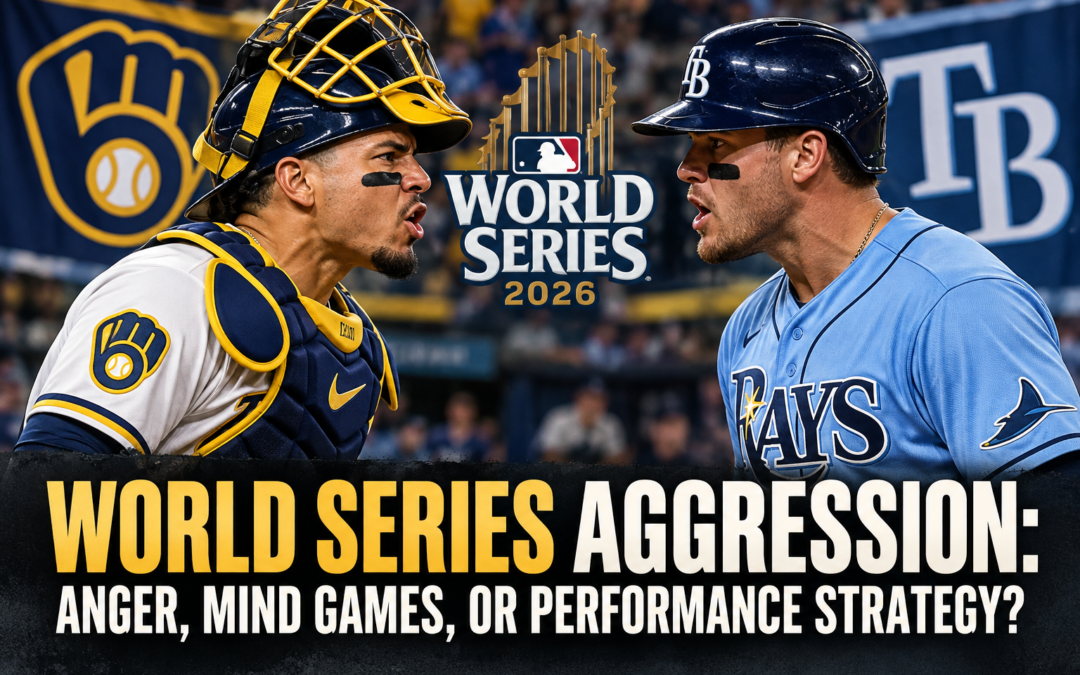
The World Series brings out some pretty interesting human behavior. Players exchange words, tempers appear to flare, and fans immediately decide who’s being aggressive, who’s losing control, and who’s to blame.
But what if we’re misreading some of those confrontations?
What if the player who looks angry isn’t losing control at all? What if he’s deliberately trying to get inside his opponent’s head?
There’s a fascinating psychological difference between losing your temper and using confrontation as a competitive strategy. And that distinction matters whether you’re watching the World Series, dealing with a difficult coworker, or interacting with someone who knows exactly how to push your buttons.
Is World Series Aggression Always About Anger?
When we see a heated exchange between baseball players, we tend to assume someone is angry. Maybe they are. But visible aggression doesn’t automatically tell us what someone is feeling, why they’re behaving that way, or what they’re hoping to accomplish.
In psychology, anger and aggression aren’t the same thing. Anger is an emotional experience, while aggression generally involves behavior intended to harm another person. Competitive gamesmanship is different again. It involves tactics designed to gain an advantage, sometimes by disrupting an opponent’s confidence, concentration, or emotional state.
These things can overlap, but they aren’t interchangeable.
A player might genuinely be frustrated. Another might be responding to something that happened earlier. And someone else might be using confrontation to shift an opponent’s attention away from the game.
Here’s the problem with watching a ten-second clip: We see the behavior, but we don’t have access to the motivation.
Yet that rarely stops us from deciding exactly what happened.
Can Aggression Actually Be a Performance Strategy?
Here’s where the research gets interesting.
A 2019 study published in the Journal of Sports Sciences, titled Effects of Antisocial Behaviour on Opponent’s Anger, Attention, and Performance, examined what happened when basketball players experienced insults or distracting comments while performing free throws.
The researchers found that insults increased anger, while both insults and distracting comments interfered with attention. Interestingly, there wasn’t an overall direct reduction in performance. However, their analysis suggested that anger could indirectly impair performance by increasing distraction.
Think about that for a moment.
You don’t necessarily have to make someone lose their temper to interfere with their concentration. Sometimes getting them to think about you instead of what they’re supposed to be doing is enough to create a problem.
And in baseball, where timing, anticipation, and split-second decisions matter, attention is a valuable resource.
But there’s an even more interesting study involving Major League Baseball itself.
In 2024, researchers published Verbal Aggressions Against Major League Baseball Umpires Affect Their Decision Making in Psychological Science. They examined more than 153,000 pitches from MLB games between 2010 and 2019, investigating whether excessive criticism of umpires influenced subsequent strike-zone decisions.
Their findings suggested that after umpires experienced excessive criticism specifically related to strike-zone calls, their subsequent decisions tended to favor the complaining team. Batters on that team were less likely to have pitches called strikes, while opposing batters were more likely to receive strike calls.
That doesn’t prove the criticism was deliberately planned or that aggression is a good strategy. The research was observational, and the findings were specific to certain types of confrontations.
But it does challenge the assumption that aggressive behavior is always nothing more than someone losing control.
Sometimes behavior that looks emotionally impulsive can also produce a competitive advantage.
And that raises a question worth considering: Are we always watching an emotional reaction, or could we sometimes be watching an attempt to influence someone else’s behavior?
Why We’re So Quick to Judge Other People’s Behavior
Here’s where World Series aggression becomes a lesson in everyday psychology.
Think about the last time somebody snapped at you. What was your immediate reaction? Maybe you thought they were rude, aggressive, or just an asshole.
Now think about the last time YOU snapped at somebody.
You probably had a perfectly good explanation. You were exhausted. You were stressed. You’d had enough. Maybe someone had been pushing your buttons all day.
Funny how our own behavior needs context, but everybody else’s apparently doesn’t.
Psychologists have a name for one part of this tendency: the fundamental attribution error. We often explain other people’s behavior in terms of their personality while overlooking the circumstances influencing their actions.
And we do it constantly. At work, in relationships, and especially on social media, where we can watch a few seconds of someone’s behavior and become remarkably confident that we understand their intentions.
But what if we’re wrong?
What if the person we think is angry is actually being strategic? What if the person we think is deliberately provocative is simply frustrated? Or what if we’re missing something that happened before the interaction even started?
We can’t always know someone’s intentions by watching their behavior.
And assuming we do can lead us to respond to a story we’ve created rather than the situation that’s actually happening.
The Hidden Cost of Taking the Bait
Now consider the other side of this.
What happens when someone really is trying to provoke you?
Maybe it’s a competitor. Maybe it’s a coworker. Maybe it’s a family member who knows exactly which comment will get a reaction. Or maybe it’s a stranger on social media who has apparently cleared their entire afternoon to argue with you.
They say something irritating. You recognize what they’re doing. And you react anyway.
Maybe you don’t even respond out loud. Instead, you spend the next three hours replaying the conversation and mentally composing a response worthy of a courtroom closing argument.
Congratulations. You’ve devoted your afternoon to somebody who isn’t even there.
The problem isn’t necessarily that you got angry. Anger is a normal human emotion, and sometimes it’s an appropriate response.
The problem is what happens when your attention becomes occupied by something that has very little to do with what you’re trying to accomplish.
You might find yourself distracted during a conversation, struggling to concentrate at work, or replaying an interaction long after it ended.
This is where the connection to human performance becomes important.
Your attention is not unlimited. The more mental energy you devote to replaying a confrontation, the less attention may be available for whatever you’re trying to do next.
What Athletes Can Teach Us About Managing Attention
One of the most useful lessons from competitive sports is that performing well doesn’t require eliminating every emotion.
Athletes experience frustration, excitement, disappointment, anger, and anxiety. Those emotions don’t automatically prevent good performance.
What matters is whether they can return their attention to the task when it counts.
A baseball player might be furious about a call, but the next pitch still requires concentration. A basketball player might be frustrated by an opponent’s comments, but the next free throw still requires execution.
And the same principle applies outside sports.
You might be irritated by something your spouse said, frustrated with a coworker, or upset about a comment online. Those feelings don’t mean you have to abandon whatever you were trying to accomplish.
The useful question becomes: What deserves my attention right now?
That’s one of the central ideas behind human performance and Human Reserve. Mental performance isn’t just about pushing harder, staying positive, or pretending you don’t experience difficult emotions. It’s about understanding how your brain uses its resources and developing the ability to direct those resources toward what matters.
Sometimes that means recognizing a distraction before you spend the next three hours entertaining it.
The Performance Strategy You Can Use Today
The next time someone says or does something that gets under your skin, resist the temptation to immediately decide what they meant.
First, consider what you actually know. Are you responding to someone’s behavior, or to the motivation you’ve assigned to it?
Then ask yourself what your reaction is likely to accomplish. Will it help resolve something important? Will it improve the situation? Or will it simply keep the confrontation going?
Finally, consider what deserves your attention next.
You don’t have to suppress your emotions, ignore genuine problems, or avoid every difficult conversation. Sometimes speaking up is exactly the right decision.
But there’s a difference between choosing to respond because something matters and reacting simply because someone got under your skin.
It’s a small shift in perspective, but it can change how you approach confrontations.
The Real Psychology Behind World Series Aggression
When two players confront each other during the World Series, it’s tempting to decide immediately who’s angry and who’s out of control.
But maybe we’re watching frustration. Maybe we’re watching competitive gamesmanship. Maybe we’re watching a deliberate attempt to interrupt someone’s concentration. Or maybe we’re missing important context entirely.
We can’t know from appearances alone.
What we do know is that attention, emotion, and decision-making are closely connected. Research suggests that verbal provocation can influence attention and, under certain circumstances, even affect decisions made by others.
That doesn’t make aggression admirable or mean every confrontation is strategic. It simply reminds us that human behavior is more complicated than it looks.
And here’s the part worth remembering long after the World Series ends.
Sometimes the person who looks like they’re losing control might be trying to make someone else lose theirs.
The next time someone gets under your skin, consider whether you’re responding to something important or simply taking the bait.
Because sometimes the smartest move is recognizing the game before deciding whether to play.
What do you think? When athletes confront each other, are we watching genuine anger, competitive strategy, or a little of both?
Research References
Ring, C., Kavussanu, M., Al-Yaaribi, A., Tenenbaum, G., & Stanger, N. (2019). Effects of antisocial behaviour on opponent’s anger, attention, and performance. Journal of Sports Sciences, 37(8), 871–877.
Guérette, J., Blais, C., & Fiset, D. (2024). Verbal aggressions against Major League Baseball umpires affect their decision making. Psychological Science, 35(3), 288–303.