
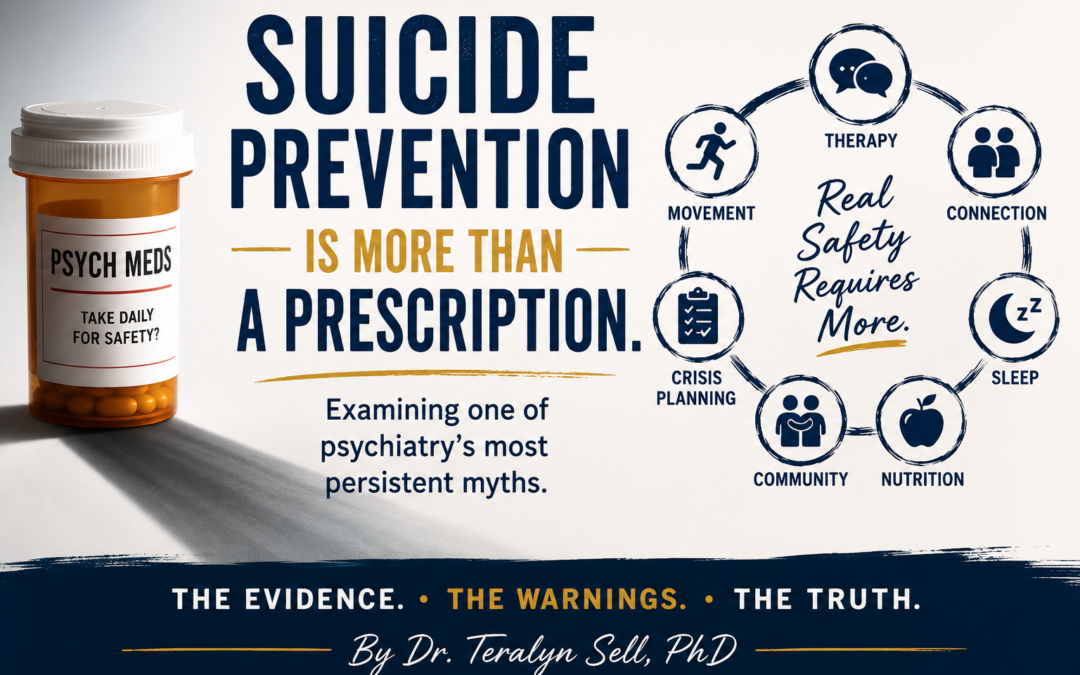
By Dr. Teralyn Sell, PhD
Clinically Reviewed by Dr. Teralyn Sell, PhD
Few beliefs in modern psychiatry carry more emotional weight than the idea that psychiatric medication is necessary to keep people safe from suicide. It is a powerful message. It is repeated in clinics, hospitals, emergency departments, and across social media. For many people, it is presented not as one possible intervention, but as the intervention that stands between life and death.
But does the evidence actually support that claim?
That is a very different question than asking whether psychiatric medication can help some people. Many individuals report meaningful symptom improvement, and medication may be an appropriate part of treatment for some. The myth worth examining is the much broader claim that medication itself is necessary for safety and will stop someone from suicide or self harm in the long term.
Suicide is one of the most complex human behaviors we know. It is influenced by psychological pain, trauma, substance use, chronic illness, financial hardship, social isolation, hopelessness, impulsivity, access to lethal means, and countless biological, psychological, and environmental factors. No single intervention can account for all of those influences.
One of the greatest contradictions in this conversation deserves far more attention.
Most antidepressants are generally expected to require several weeks before their full antidepressant effects emerge. Yet they are often initiated during periods of acute crisis. That raises an important question. If a medication is generally understood to require weeks before its intended therapeutic effects are realized, what is the mechanism by which it is presumed to provide immediate protection against suicide? That question deserves thoughtful discussion rather than assumptions.
The conversation becomes even more nuanced when we examine the prescribing information itself.
Antidepressants carry a boxed warning from the U.S. Food and Drug Administration describing an increased risk of suicidal thoughts and behaviors in children, adolescents, and young adults during the early stages of treatment. The prescribing information also advises careful monitoring after treatment is initiated and during dosage increases or decreases because changes in medication exposure may be accompanied by clinical worsening, unusual behavioral changes, or emerging suicidality in some individuals.
Those warnings matter.
They remind us that the relationship between psychiatric medication and suicidality is not simple. If careful monitoring is recommended when medication is started, increased, decreased, or discontinued because suicidal thoughts or behaviors may emerge or worsen, then it is difficult to argue that medication should be viewed as a universally protective intervention or the sole foundation of safety.
Clinical research also deserves careful interpretation. Most antidepressant trials are designed to evaluate changes in symptoms over several weeks. They are generally not designed, or statistically powered, to determine whether a medication prevents suicide over months or years. Suicide is fortunately a relatively uncommon outcome, making it difficult for randomized clinical trials to demonstrate a direct reduction in suicide deaths attributable to medication alone.
More importantly, the overall evidence remains uncertain. Recent systematic reviews continue to conclude that the relationship between psychiatric medication and suicide cannot be reduced to a simple conclusion. Some observational studies have reported lower suicide rates in certain medicated populations. Others have found little meaningful difference between medicated and non-medicated groups, while some have reported higher rates during particular periods of treatment or in specific patient populations. One of the greatest challenges in interpreting these studies is that individuals prescribed psychiatric medication are often already at higher baseline risk of suicide, making it difficult to determine whether differences are due to the medication, the underlying illness, or other factors. The evidence is far more nuanced than the public is often led to believe.
That distinction matters because uncertainty is not the same as proof.
Perhaps the greatest myth is not that medication can never help.
It is the belief that medication alone creates safety.
Safety has never been a prescription.
Safety is built through comprehensive assessment, therapeutic relationships, crisis planning, treatment of substance use when present, attention to physical health, sleep, nutrition, family involvement, meaningful human connection, reducing access to lethal means, and ongoing follow-up. Medication may be one component of that process for some people, but it has never been the entire strategy.
The danger of oversimplified messaging is that it narrows the conversation. When medication is portrayed as the primary safeguard against suicide, other evidence-informed interventions can receive less attention. Families may believe there is only one acceptable path. Clinicians may feel pressured to prescribe in situations where uncertainty remains. Individuals may conclude that if medication does not help, nothing else will.
That is not what the evidence tells us.
Suicide prevention has always required a comprehensive approach. It requires understanding the person’s history, current circumstances, strengths, stressors, relationships, physical health, substance use, and sources of hope. It requires biological, psychological, social, and environmental interventions working together. Most importantly, it requires acknowledging uncertainty rather than replacing it with certainty that the evidence has not fully earned.
People deserve more than reassuring slogans.
They deserve evidence.
They deserve informed consent.
And they deserve honest conversations about what we know, what we do not know, and why protecting human life has always required far more than a prescription pad.