
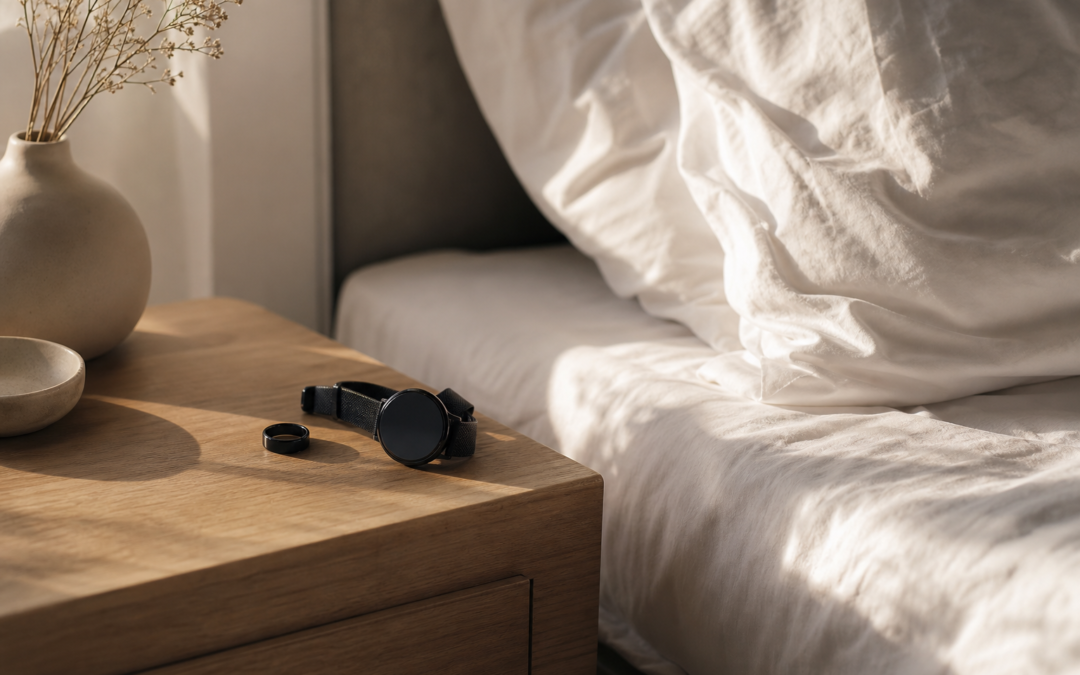
A sleep score has become a kind of morning weather report.
You wake up, look down, and get a number that seems to explain the day before the day has even started. Eighty-seven: promising. Fifty-nine: concerning. The number may shape how you interpret your energy, your mood, your ability to handle a hard conversation, or whether that afternoon slump means something is wrong.
I understand the appeal. Sleep is consequential, difficult to observe from the inside, and full of uncertainty. A number offers the feeling of a clean answer.
But a sleep score is not recovery. It is a device’s estimate, built from a particular set of signals and an algorithm, of selected aspects of a complicated biological process. That can be useful. It is not the same thing as knowing what remains available to you in the life you have to live today.
The measurement problem starts with the name
“Sleep score” sounds more definitive than it is.
Most consumer devices do not measure sleep directly in the way a clinical sleep study does. They commonly use movement, heart rate, and related signals to infer whether someone was asleep, awake, or in a particular sleep stage. That inference may be reasonably useful for seeing broad patterns over time. But it is still an inference.
A 2025 meta-analysis of 24 studies comparing wrist-worn consumer trackers with polysomnography, the more comprehensive laboratory method, found meaningful differences across measures including total sleep time, sleep efficiency, sleep latency, and wake after sleep onset. A large multicenter validation study of 11 consumer trackers also found that accuracy varied considerably by device and by sleep stage.
None of this means the devices are useless. It means we should stop treating a tidy summary score as if it were a direct reading of what happened in the brain, much less a verdict on how well a person will function tomorrow.
That leap is where the trouble begins.
A score can be accurate enough to be interesting and still miss the point
Suppose your tracker reports a mediocre night. You may still get through a demanding morning with unusual clarity, make good decisions, feel patient with your children, and have enough energy left to enjoy dinner with someone you love.
Or suppose the number looks excellent. You may still feel mentally dull, emotionally flat, unusually reactive, or unable to focus on the work in front of you.
Neither experience proves the tracker “wrong.” It shows that the score and the outcome are measuring different things.
This distinction gets lost because numbers feel objective while experience feels fuzzy. But experience is where sleep matters. Sleep matters because of what it changes in attention, judgment, energy, learning, emotional range, recovery, and participation in a real day. A morning score may provide one clue. It cannot settle the larger question.
The American Academy of Sleep Medicine made a similar distinction in its position statement on consumer sleep technology: these tools may support conversations and awareness, but they were not positioned as substitutes for a comprehensive sleep evaluation or for diagnosing and treating sleep disorders.
That is a useful boundary even outside a clinical setting. A device can observe a pattern without explaining it. It can flag a change without telling us what that change means. And it can generate an impressive-looking composite score without establishing whether the person is actually restored.
When tracking becomes another demand
Here’s where this gets more interesting. The problem is not only measurement accuracy. It is also what a measurement does to the person being measured.
For some people, sleep tracking is neutral or helpful. It might reveal that late meetings, alcohol, travel, shift work, or a new baby are disrupting a previously invisible pattern. That is legitimate information.
For others, the score becomes a nightly performance review. A less-than-ideal number creates worry. Worry changes bedtime behavior. Bedtime becomes an attempt to produce the right data rather than a chance to sleep.
Researchers coined the term orthosomnia in a 2017 case report describing patients whose preoccupation with tracker data appeared to reinforce sleep-related anxiety or perfectionism. It was a small case series, not evidence that trackers routinely cause insomnia. Still, it points to a problem we should take seriously: a tool intended to reduce uncertainty can sometimes become another source of cognitive load.
That is the capacity question hiding underneath the technology. Is the information helping someone orient to their life more clearly? Or is it consuming attention, creating a new standard to chase, and making one imperfect night feel like a compromised day before the day has begun?
Recovery is bigger than the night
We also tend to make sleep carry too much explanatory weight. A disappointing day can reflect sleep, certainly. It can also reflect grief, illness, caregiving, conflict, under-fueling, an overloaded calendar, a long commute, chronic pain, financial pressure, or simply a stretch of life that has left very little margin.
A recovery score can make that complexity disappear. It offers a single cause where there may be several.
And that can quietly distort the goal. The goal is not to achieve a flawless graph. The goal is not even to collect a high average. The goal is to understand whether a person has enough access to themselves for the demands and possibilities of their actual life.
Can they think when thinking matters? Can they recover after effort? Can they stay connected to other people? Is functioning coming with enough margin, or are they getting through the day by spending everything they have?
A wearable may be part of that inquiry. But it should remain a witness, not the judge.
The better question in the morning may not be, “What did my device say about last night?” It may be, “What changed in my actual life today, and what information would help me understand that more honestly?”