
Medically reviewed by Dr. Teralyn Sell, PhD
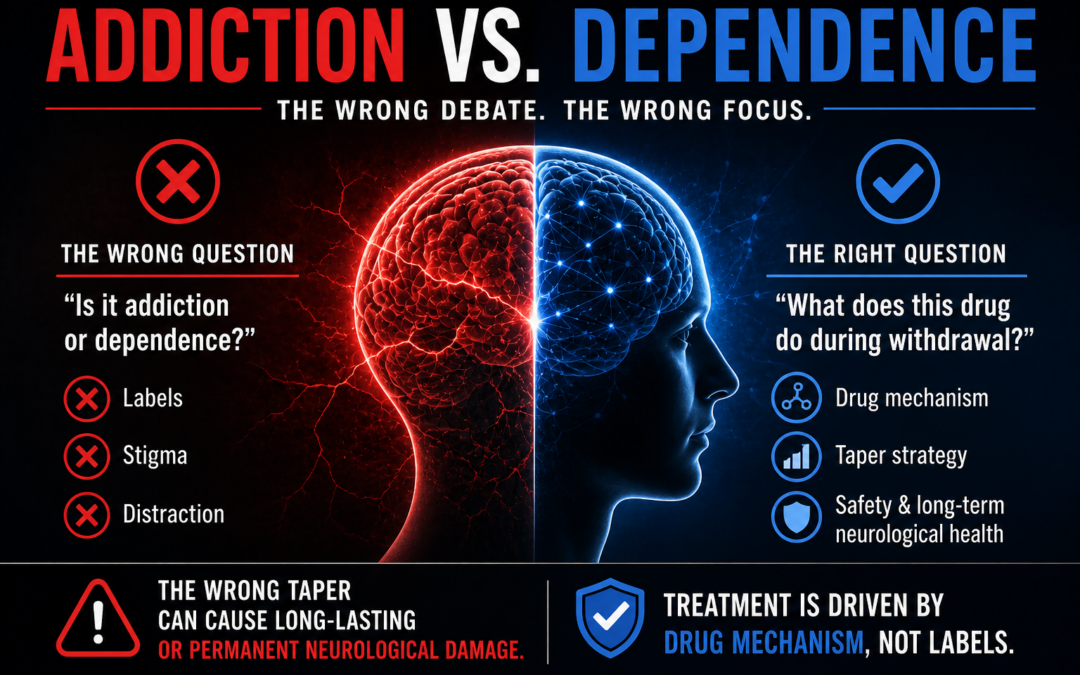
Let’s be precise. Treatment is not built on whether something is called “addiction” or “dependence.” It is built on what the drug does during withdrawal. Mechanism of action drives risk. Mechanism drives pacing. Mechanism determines what is safe, what is dangerous, and what needs structure. The label does not.
Yet the public conversation stays stuck in labels.
People argue whether psychiatric medications are “addictive.” Others counter with “just dependence.” Both sides miss the point. Those words do not determine detox protocols, tapering speed, monitoring, or risk mitigation. Neuroadaptation does. Receptor changes do. Half-life does. That is what dictates whether someone destabilizes, how quickly symptoms emerge, and what it takes to come off safely.
We already accept this in other domains. Alcohol withdrawal is treated as high-risk because of its GABA-related mechanism and seizure potential. Opioid withdrawal is managed differently because of opioid receptor dynamics and a more predictable, though still serious, course. The approach is not moral. It is mechanical.
Then we step into psychiatric medications and abandon that clarity.
These drugs also create physiological adaptation. They also have withdrawal signatures. They also require pacing based on pharmacology. Yet they are often managed without the same level of structure, acknowledgment, or consistency. Not because the biology is absent, but because the classification is different. The system treats them as if mechanism is secondary.
That is the error.
When mechanism is ignored, everything compresses into “symptoms returned.” Withdrawal gets mislabeled as relapse. Instability is interpreted as proof the medication is needed. The loop closes quickly, not because it is accurate, but because it is efficient.
This is not a language problem. It is a model problem.
And here is the part that is not discussed enough: the wrong type of taper is not just uncomfortable—it can be harmful. When dose reductions outpace what the brain can physiologically adapt to, the nervous system can destabilize in ways that are not short-term. People can experience prolonged neurological symptoms that persist well beyond the taper itself. In some cases, those changes can be long-lasting, if not permanent. That risk is not theoretical. It is a direct consequence of ignoring mechanism and forcing timelines that do not match biology.
If treatment were anchored to mechanism:
- Withdrawal risk would be anticipated, not debated
- Tapering would be structured, not improvised
- Symptom return would be analyzed by timing and pattern, not assumed
Instead, we default to categories that do not guide action.
And yes, this has consequences.
When the framework is misaligned with biology, people are exposed to avoidable instability. They are rushed through changes that their physiology cannot support. They are told their experience is relapse when it may be withdrawal. Over time, this shapes identity and locks in decisions that were never fully evaluated.
That is how people end up in peril.
The uncomfortable truth is this: we have known enough about mechanism to do better, and yet the system continues to prioritize classification over physiology. That is not neutral. It determines what options are visible, what risks are acknowledged, and how decisions are made in real time.
The correction is not to redefine addiction or defend dependence.
The correction is to ask a better question:
Given this drug’s mechanism, what does a safe, accurate withdrawal and treatment pathway actually require?
That question changes everything.
Because once you anchor to mechanism, you can no longer hide behind labels.