
Medically reviewed by Dr. Teralyn Sell, PhD
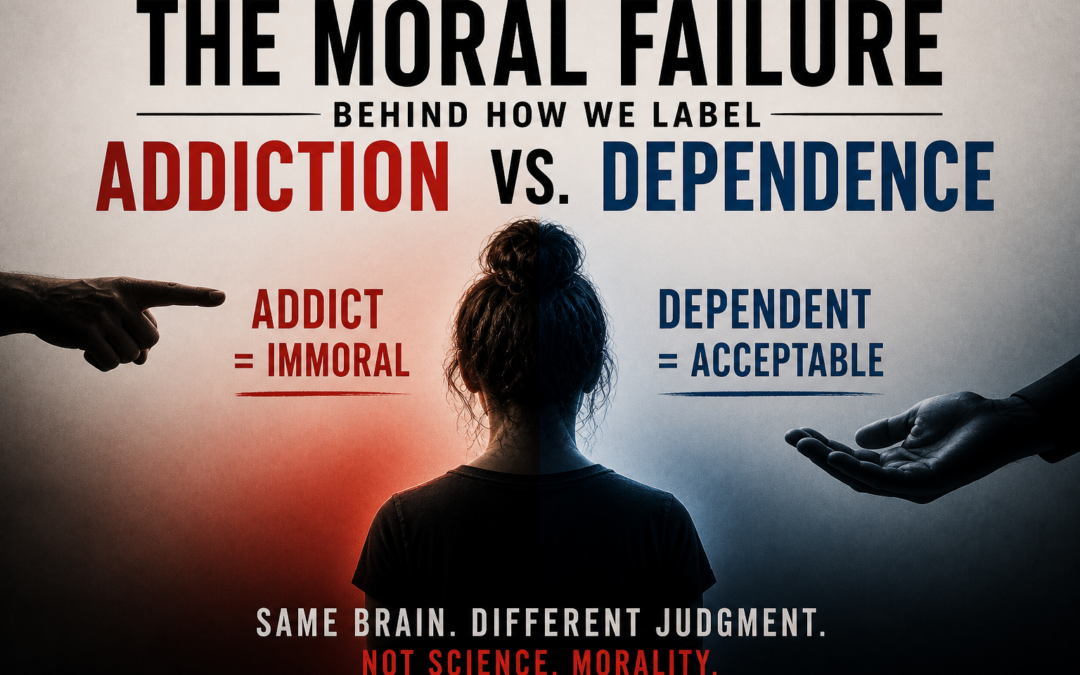
The addiction versus dependence debate is being framed as clinical. It isn’t. It is a moral argument being passed off as science, and it is distorting how mental health treatment decisions are made.
If you listen closely, the distinction is not being drawn based on mechanism. It is being drawn based on comfort. “Dependence” is used to signal something acceptable, expected, even appropriate within medical care. “Addiction” is used to signal excess, loss of control, or personal failure or doing ‘immoral’ things like lying, cheating and stealing. The language shifts, but the underlying physiology does not. Both involve neuroadaptation. Both can produce withdrawal. Both can alter behavior, cognition, and function. The biology overlaps far more than the conversation allows.
So what is actually being distinguished?
Not the brain.
The person.
That is the moral failure.
When a biological process is filtered through a moral lens, accuracy drops. The label begins to shape perception instead of reflecting reality. If something is called “dependence,” it is often minimized. Withdrawal risk is downplayed. The need for structured tapering is treated as optional or unnecessary. If something is called “addiction,” it is often escalated. The focus shifts to control, restriction, or long-term management models. Same underlying adaptation. Different response based on the label applied.
That is not precision. That is bias.
And it shows up in treatment decisions.
The system does not actually operate on the addiction versus dependence distinction in the way people think it does. Treatment is driven by mechanism of action, particularly during withdrawal. Alcohol is managed with structured detox protocols because of its GABA-related effects and seizure risk. Opioids are managed with specific frameworks because of opioid receptor dynamics and predictable withdrawal patterns. These decisions are not based on whether something is labeled addiction or dependence. They are based on what the drug does to the brain and body.
Then we step into psychiatric medications and the conversation shifts.
The same principles should apply. These medications also create neuroadaptation. They also produce withdrawal. They also require pacing that matches physiology. Yet instead of anchoring decisions in mechanism, the conversation often collapses into language. If a medication is described as “non-addictive,” it is treated as lower risk, even when withdrawal patterns are well documented. That is not a biological conclusion. That is a linguistic one.
This is where people need to be called out.
If your distinction between addiction and dependence does not change how you assess withdrawal risk, tapering strategy, or long-term outcomes, then it is not clinically meaningful. It is narrative. And that narrative is influencing care whether it is acknowledged or not.
The consequences are not theoretical.
When withdrawal is minimized, it is misinterpreted.
When tapering is unstructured, instability increases.
When symptoms return, they are labeled as relapse without adequate evaluation.
This creates a closed loop. The medication is reinforced, not because the interpretation is correct, but because the system did not allow for a more accurate one.
And there is a deeper risk that is rarely addressed.
When tapering does not respect mechanism, when reductions outpace the brain’s ability to adapt, the nervous system can destabilize in ways that are not short-term. People can experience prolonged neurological symptoms that extend far beyond the taper itself. In some cases, those changes can be long-lasting, if not permanent. That is not an edge case. It is the predictable outcome of ignoring biology.
This is not about defending addiction or redefining dependence. It is about refusing to let moral framing dictate clinical decisions.
If you want to use these terms, then raise the standard. Define them in a way that connects to physiology. Show how they change what you do next. Tie them to mechanism, not perception. If you cannot do that, then the distinction is not serving the patient. It is serving the system.
The brain does not respond to labels. It responds to receptor changes, signaling pathways, and time. It responds to how quickly something is introduced or removed. It responds to whether the process aligns with biology or overrides it.
The addiction versus dependence debate feels like the main issue.
It isn’t.
It is a contained argument that allows the real issue to remain unexamined.
The real issue is this: treatment decisions are being shaped by language when they should be shaped by mechanism.
Until that changes, the outcomes will not.