
Medically reviewed by Dr. Teralyn Sell, PhD
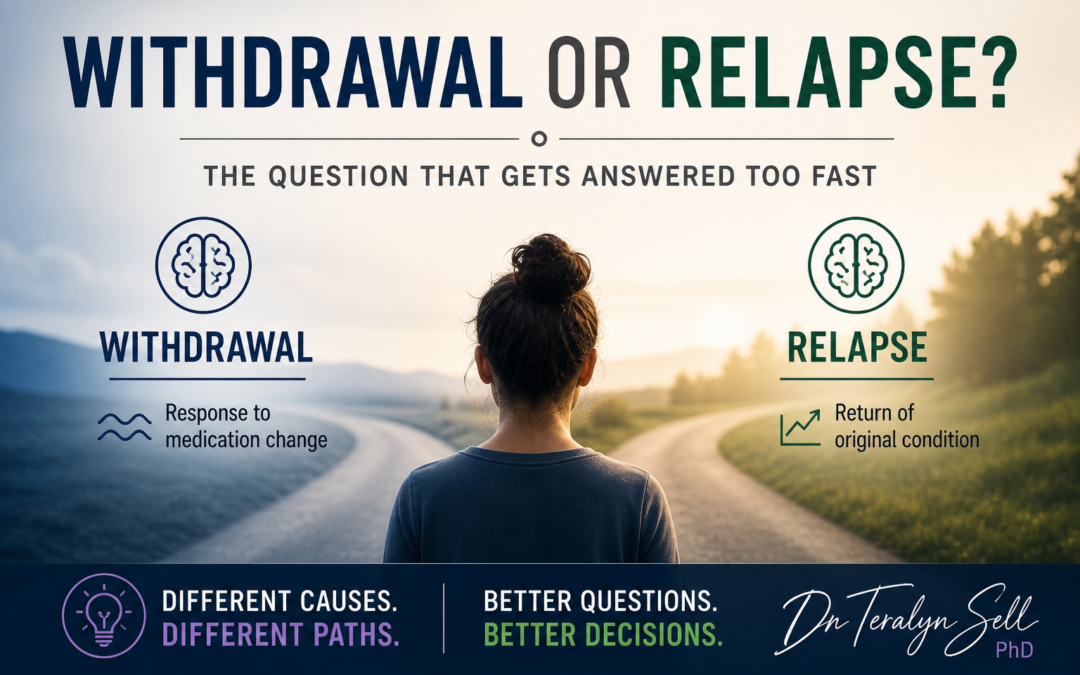
One of the most common and costly mistakes in mental health is answering the question of withdrawal versus relapse too quickly. Symptoms return, mood shifts, anxiety increases, and the default conclusion is often relapse. This response is fast, familiar, and widely accepted. It is also frequently incomplete. The reality is that withdrawal symptoms and relapse can look nearly identical in the short term, yet they represent very different processes. Withdrawal is a physiological response to a change in medication, while relapse is the return of the original condition. On the surface, both can present with anxiety, insomnia, mood instability, irritability, and cognitive disruption. Without careful attention to timing, pattern, and context, the distinction is not obvious. This is where decision-making begins to break down.
The system tends to favor speed. When symptoms appear, there is pressure to act. In many cases, this leads to withdrawal being labeled as relapse without a full evaluation. Once that label is applied, the next step often follows automatically. Medication may be reinstated or increased, and the person may come to believe they cannot function without it. This reinforces a narrative that may not have been fully tested. Over time, this shapes long-term outcomes, not because the conclusion was correct, but because it was made quickly and then repeated.
What often gets missed is that withdrawal has patterns. It frequently follows dose changes, can come in waves, and may include physical symptoms that were not present before. It can also improve with time and stabilization. Relapse has its own patterns, but when both are reduced to the simple idea that “symptoms returned,” the analysis stops too early. This is not a lack of information. It is a failure to interpret the information with enough precision. When everything is treated as relapse, the opportunity to observe and differentiate is lost.
This distinction matters because it directly affects decision integrity. If withdrawal is mistaken for relapse, the intervention that follows may not match the underlying process. Decisions are then made based on an inaccurate assumption. This shortens the timeline, limits observation, and reduces the ability to gather meaningful data. Good mental health decisions require more than symptom recognition. They require an understanding of what is driving those symptoms and how they change over time.
A more accurate approach is to shift the question. Instead of asking whether symptoms mean relapse, the better question is what explanation best fits the timing, pattern, and context. This slows the process down and allows for a more complete evaluation. It creates space for observation instead of immediate correction. Not every return of symptoms signals relapse, and not every difficult period requires a change in medication. The risk is not the presence of symptoms. The risk is mislabeling their cause and building decisions on that misinterpretation.