
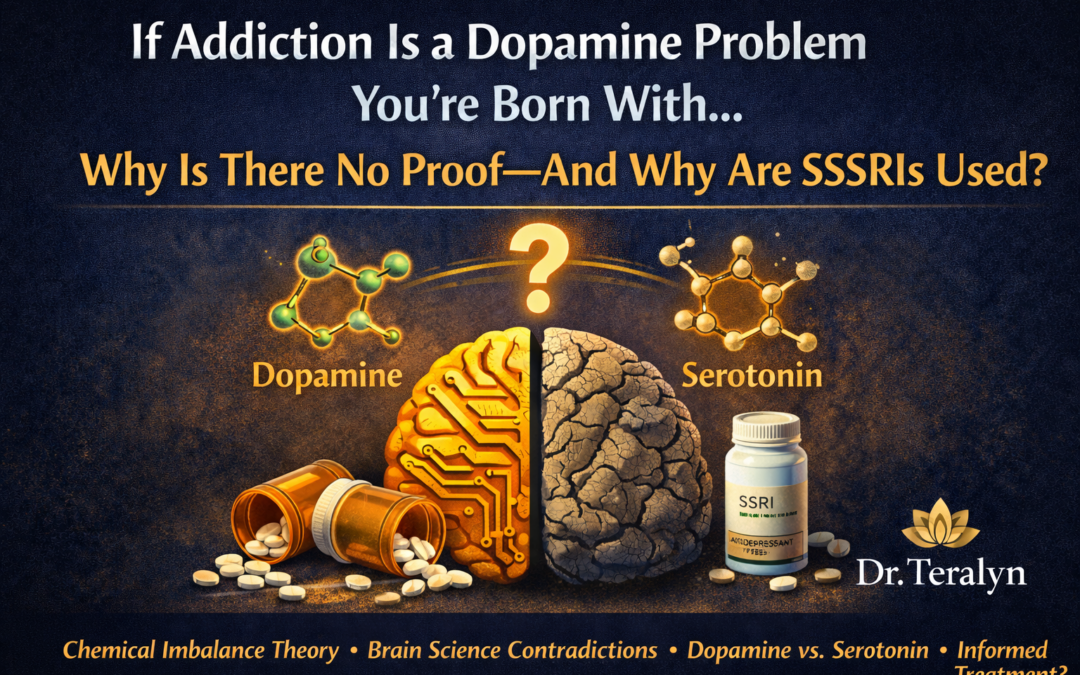
One of the strangest contradictions in addiction treatment is this: people are told they are born with a broken brain, specifically a dopamine signaling problem, yet there is no clear proof this is true. Even more confusing, when addiction is framed as a dopamine disorder, many people are treated with medications that do not target dopamine at all. This includes SSRIs, which mainly affect serotonin. These two ideas do not line up.
The “born with a broken brain” theory claims that some people are born with faulty dopamine systems that make them more likely to become addicted. Dopamine is involved in motivation, reward, and learning, so the story sounds scientific. But there is no reliable test that shows someone was born with a dopamine defect that causes addiction later in life. There is no brain scan, blood test, or genetic marker that proves this theory in real people. What exists instead are theories based on averages, animal studies, and brain changes seen after substance use has already started.
This is a key point. Once someone uses drugs or alcohol repeatedly, dopamine signaling does change. The brain adapts. Motivation shifts. Pleasure can feel blunted. These are real changes. But they happen after exposure, not before. Changes caused by substance use are often mistaken as proof that the brain was broken all along. That is backwards reasoning.
If addiction were truly caused by a lifelong dopamine defect present at birth, treatment would logically focus on dopamine in a precise way. Instead, many people with addiction are prescribed SSRIs. SSRIs primarily affect serotonin, not dopamine. Serotonin is involved in mood, sleep, and emotional regulation. It is not the main driver of reward or craving. This raises an important question: if addiction is a dopamine disease, why is the most common medication choice aimed at a different neurotransmitter?
There is no strong evidence that SSRIs correct a dopamine-based addiction problem. In some cases, SSRIs may even blunt motivation, emotional range, or reward sensitivity. For someone already struggling with low motivation or pleasure, this can make recovery harder, not easier. Yet this contradiction is rarely discussed openly with patients.
This does not mean people with addiction do not have real brain changes. They do. Substance use changes dopamine, stress hormones, sleep patterns, and emotional regulation. Withdrawal creates real symptoms. Cravings are real. Distress is real. But none of this proves someone was born broken. It shows the brain is adaptive. It responds to what it is exposed to.
The same flawed logic shows up in mental health treatment. People are told they were born with low serotonin, yet there is no baseline test proving this. Medications are prescribed first, and explanations come later. When symptoms appear during withdrawal, they are often labeled as proof of an underlying disorder rather than expected brain adaptation.
A more honest model would say this: brains change with experience. Substances and medications create adaptations. Those adaptations can feel severe, but they are not evidence of a lifelong defect. Recovery requires time, pacing, education, and brain health support—not fear-based stories about permanent damage.
The real question is not why people struggle. The question is why a theory with no direct proof is treated as fact, and why treatments are used that do not match the explanation given. Until those contradictions are addressed, both the addiction and mental health communities will continue to confuse adaptation with disease—and people will continue to blame themselves for brains that were never broken to begin with.
Medically reviewed by Dr. Teralyn Sell, PhD