
By Dr. Teralyn Sell, PhD
Zero sugar. Zero calories. But what about your mood?
For years, diet soda has been marketed as the smarter choice. All the sweetness, none of the sugar, and none of the calories.
Sounds like a pretty good deal.
But what if we’ve been paying attention to the wrong numbers?
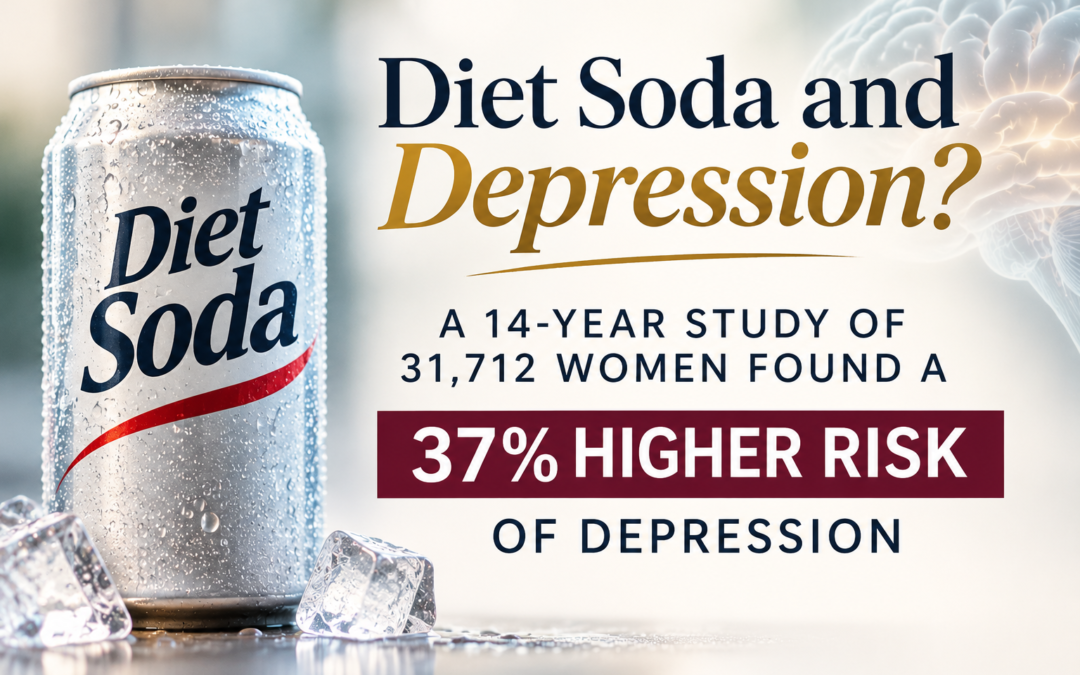
A large study involving more than 31,000 women found something worth questioning: women who consumed the most artificially sweetened beverages had a 37% higher relative risk of developing depression compared with women who consumed the least.
Before you dump every diet soda in your refrigerator, there’s something important we need to discuss.
What did the researchers actually find? And what does that 37% really mean?
What Did the 14-Year Harvard Study Find?
In 2023, researchers published a study in JAMA Network Open examining the relationship between ultra-processed foods and depression.
The research included 31,712 women participating in the Nurses’ Health Study II. They were between 42 and 62 years old at the beginning of the study and were followed from 2003 to 2017.
Researchers assessed dietary intake every four years and examined which women subsequently reported depression diagnoses and antidepressant use.
The findings were interesting.
Compared with women consuming the least:
- Women consuming the most artificially sweetened beverages had a 37% higher relative risk of depression.
- Women consuming the most artificial sweeteners had a 26% higher relative risk.
- Women consuming the most ultra-processed foods had approximately a 49% higher relative risk, using the study’s stricter definition of depression.
And here’s what caught my attention.
When researchers examined individual categories of ultra-processed foods, artificially sweetened beverages and artificial sweeteners stood out as the categories associated with increased depression risk after adjustment for multiple other factors.
That’s worth examining.
Does This Mean Diet Soda Causes Depression?
No. And this is where understanding research becomes important.
This was an observational study. Researchers followed participants and looked for relationships between dietary patterns and subsequent depression.
They did not randomly assign women to drink diet soda or avoid it.
That means the study identified an association. It did not establish causation.
Researchers adjusted for numerous factors, including physical activity, smoking, body mass index, sleep, and certain medical conditions.
But statistical adjustments cannot eliminate every possible explanation.
For example, could people who regularly consume artificially sweetened beverages have other dietary or lifestyle characteristics that influence depression risk?
Possibly.
Could the sweeteners themselves play a role?
Also possible.
The study raises a legitimate question. It does not settle it.
What Does a 37% Higher Risk Actually Mean?
This is one of the most misunderstood parts of health research.
A 37% higher relative risk does not mean that 37% of women who drink diet soda will develop depression.
It also doesn’t mean your personal probability of depression increases by 37 percentage points.
The figure compares the relative rate of depression between groups with different levels of artificially sweetened beverage consumption.
Without understanding the underlying absolute risk, we cannot translate that number directly into an individual’s likelihood of developing depression.
And that distinction matters.
A percentage can sound dramatic while telling us surprisingly little about what will happen to any one person.
How Might Artificial Sweeteners Be Connected to Mood?
Researchers discussed possible biological mechanisms involving brain signaling, including purinergic transmission.
But the actual mechanism remains uncertain.
There are still unanswered questions about whether particular sweeteners, combinations of ingredients, overall dietary patterns, or other factors account for the observed association.
And the study did not establish that artificially sweetened beverages alter neurotransmitters in a way that causes clinical depression.
It’s tempting to take a biological theory and present it as an explanation.
But a plausible mechanism is not the same thing as a demonstrated cause.
Here’s the Question I Think We Should Be Asking
We’ve spent decades discussing food primarily in terms of calories, carbohydrates, sugar, and weight.
But what about cognitive function? Mood? Energy? Long-term mental health?
If a beverage contains zero calories, does that automatically make it a better choice for every outcome we’re trying to improve?
Of course not.
And if a study identifies a relationship between a common dietary habit and depression, shouldn’t we be willing to examine that relationship without immediately turning it into either a frightening headline or a reason to dismiss the research?
That’s the distinction I want people to understand.
We don’t need to declare diet soda dangerous to acknowledge that we may not know everything about its long-term effects.
And we don’t need proof of causation before asking better questions about what we’re consuming.
Watch: Diet Soda and Depression — The Hidden Risks to Your Mood
In my latest YouTube video, I break down the findings from this 14-year study, what the 37% figure means, and why the relationship between nutrition and mental health deserves more attention.
Watch the full video: https://youtu.be/7E8v_L94GZo
The Bottom Line
This study doesn’t prove that drinking diet soda causes depression.
It does show that, among more than 31,000 women followed over 14 years, greater consumption of artificially sweetened beverages was associated with a higher risk of subsequently reported depression.
That’s a finding worth taking seriously without exaggerating what it means.
Because when it comes to brain health, the question shouldn’t simply be whether something has sugar or calories.
It should also be whether we’re measuring the outcomes that matter.
Question Everything. Assume Nothing.
Research and Sources
Original peer-reviewed study:
Samuthpongtorn C, Nguyen LH, Okereke OI, et al. (2023). Consumption of Ultraprocessed Food and Risk of Depression. JAMA Network Open, 6(9), e2334770.
https://jamanetwork.com/journals/jamanetworkopen/fullarticle/2809727
Harvard T.H. Chan School of Public Health:
Ultra-processed foods may increase risk of depression.
https://hsph.harvard.edu/news/ultra-processed-foods-may-increase-risk-of-depression/
This article is educational and does not establish that any individual beverage or ingredient causes depression.