
What the Tampa Bay Buccaneers can teach us about cognitive flexibility, decision-making, and performance under pressure.
Reviewed by Dr. Teralyn Sell, PhD
The Tampa Bay Buccaneers won a football game without completing a single pass. That’s an unusual way to win in today’s NFL, but it’s also an interesting example of cognitive flexibility in sports. When conditions change, successful performance may depend less on executing the original plan and more on recognizing when that plan needs to change.
The Tampa Bay Buccaneers won a football game without completing a single pass.
Read that again.
In a league where quarterbacks, passing yards, and explosive plays dominate the conversation, Tampa Bay found a way to win by doing something entirely different.
And that raises an interesting question.
When the conditions change, how long should you keep doing what you originally planned?
It’s a question that matters in football. It also matters in business, leadership, and just about any situation where you’re expected to perform under pressure.
The Game That Challenged the Usual Formula
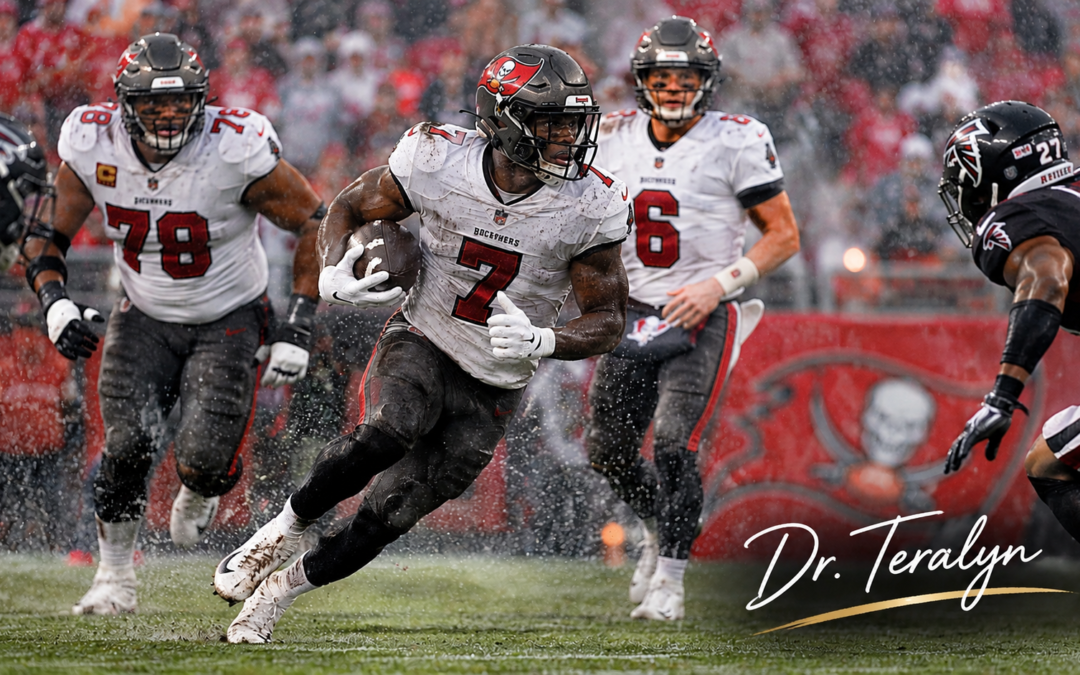
On November 1, 2026, the Buccaneers defeated the Atlanta Falcons 16–0 in heavy rain at Raymond James Stadium.
Baker Mayfield attempted three passes. He completed none.
Meanwhile, Tampa Bay rushed for 324 yards, setting a franchise record. Bucky Irving contributed 170 yards and a touchdown. Kenny Gainwell added another 140 yards.
The defense intercepted Atlanta quarterback Michael Penix Jr. four times.
It was the first NFL game since 1974 in which a team finished without a completed pass.
Tampa Bay Buccaneers+2
Think about the contrast.
The Falcons attempted 24 passes and completed eight. Tampa Bay attempted three and completed zero.
One team kept trying to move the ball through the air. The other relied almost entirely on the ground game.
The result wasn’t close.
But here’s where the psychology gets interesting.
Cognitive Flexibility: Knowing When to Change the Approach
In psychology, cognitive flexibility refers to our ability to adjust our thinking and behavior when circumstances change.
It’s an important part of executive functioning.
We use it when we recognize that a familiar solution isn’t working, when new information changes our assessment, or when the demands of a situation require a different approach.
And it’s not the same thing as being indecisive.
In fact, changing strategies can require considerable judgment, particularly when you’ve invested time, resources, and confidence in the original plan.
The Buccaneers game offers a useful illustration.
Heavy rain changed the conditions for both teams. Passing became difficult. Ball security mattered. Field position mattered.
Tampa Bay’s offense relied on a running game that was producing results.
We can’t know the precise reasoning behind every coaching decision without hearing from the people making them. But the observable difference is striking: Tampa Bay attempted only three passes in an entire NFL game.
That raises a question worth considering.
How often do we continue using a familiar strategy because it’s familiar, rather than because it’s still effective?
When Persistence Becomes a Thinking Error
We tend to admire persistence.
And for good reason. Consistency, preparation, and sustained effort are important parts of performance.
But persistence can become a liability when it prevents us from incorporating new information.
Psychologists study several thinking patterns that help explain this.
-
Cognitive rigidity: Difficulty shifting away from an established approach when circumstances change.
-
Sunk-cost thinking: Continuing to invest in something because of what we’ve already committed, rather than evaluating what makes sense next.
-
Confirmation bias: Giving more weight to information that supports our existing expectations while overlooking evidence that challenges them.
These are useful concepts for examining decisions. They are not diagnoses of what happened inside either team’s locker room.
That’s an important distinction.
We can analyze the decisions visible on the field without claiming to know the psychological state of the players or coaches.
And we should be equally careful about assuming that Atlanta’s passing attempts alone explain the loss. Tampa Bay’s rushing success, defensive performance, and Atlanta’s turnovers all contributed to the outcome.
The broader point is that changing conditions should change the information we use to make decisions.
The Difference Between a Good Decision and a Good Outcome
Here’s another interesting part of this game.
Tampa Bay won 16–0, but that doesn’t mean every decision the Buccaneers made was correct.
At one point, Bucky Irving lost a fumble through the end zone, resulting in a touchback. The offense also settled for field goals after opportunities created by interceptions.
Tampa Bay Buccaneers+1
Winning doesn’t erase those mistakes.
This is where outcome bias becomes relevant.
Outcome bias occurs when we judge the quality of a decision primarily by how things turned out.
We do this constantly.
A business makes a risky decision and earns a profit. We call the decision brilliant.
Another business makes a carefully considered decision and encounters an unexpected setback. We call it a failure.
But neither outcome tells us everything about the quality of the original judgment.
The same applies to sports.
A winning team can make poor decisions. A losing team can make sound decisions that don’t produce the desired result.
The quality of a decision and the outcome of that decision are related, but they are not interchangeable.
That’s particularly important in environments where uncertainty is unavoidable.
What This Means Beyond Football
Imagine an executive whose company has relied on the same strategy for years.
The market changes. Customer behavior shifts. New competitors emerge.
But leadership keeps returning to the original strategy because it worked before.
Or consider a professional who has spent years developing a particular way of solving problems.
When that approach stops producing results, the immediate response may be to work harder rather than reconsider the method.
The problem may not be insufficient effort.
It may be an unwillingness to update the decision.
That is where cognitive flexibility becomes a performance advantage.
Not because flexibility guarantees success.
It doesn’t.
But because effective judgment requires the ability to distinguish between information that remains relevant and assumptions that no longer fit the situation.
The Real Performance Question
The Buccaneers didn’t need an impressive passing performance to win.
They needed to produce results under the conditions they actually faced.
And on November 1, their running game and defense were enough to deliver a shutout.
There is a larger lesson here, but it isn’t simply that everyone should abandon a strategy when things become difficult.
Sometimes persistence is appropriate. Sometimes the best decision is to stay with a plan despite temporary setbacks.
The challenge is knowing the difference.
That requires more than confidence.
It requires attention to changing conditions, willingness to reconsider assumptions, and the discipline to evaluate decisions independently of the final score.
Because sometimes the most important performance skill isn’t knowing how to execute your original plan.
It’s knowing when the original plan is no longer the right one.