
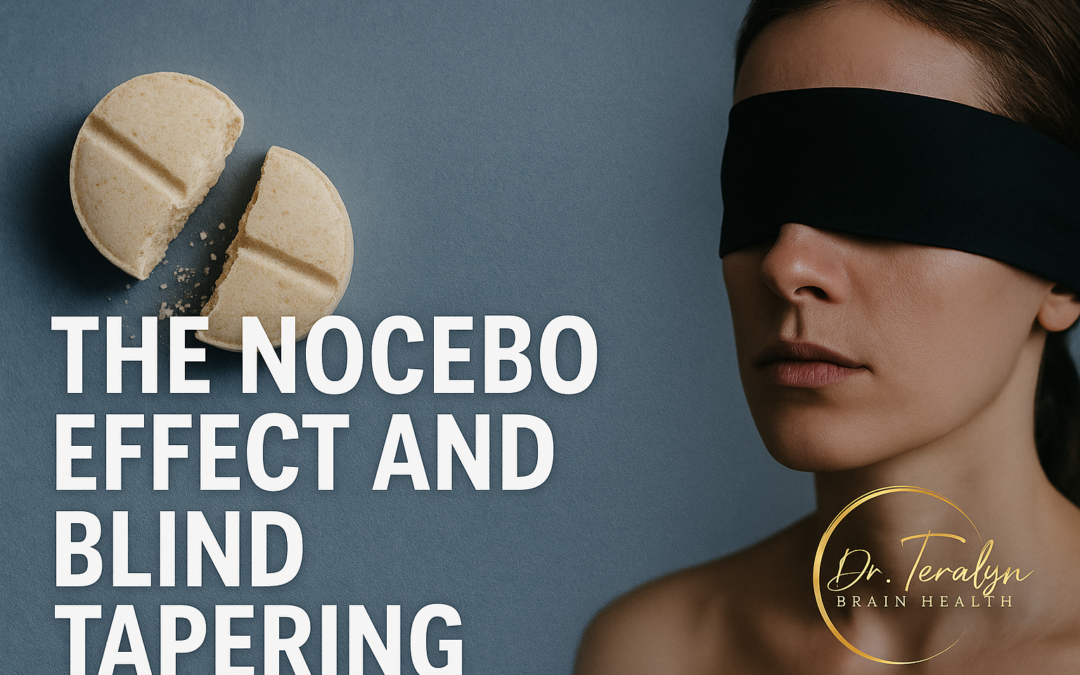
Why Control, Consent, and Expectation Matter as Much as the Dose
Blind tapering is controversial, and it should be. Any approach that alters how information is shared during medication withdrawal deserves careful scrutiny, not blind acceptance or rejection. The discomfort around blind tapering is not really about the method itself. It is about power, trust, and the ethical obligation to protect the person doing the taper.
To understand why blind tapering can sometimes reduce suffering and why it can also be inappropriate, we have to start with the nocebo effect.
When Expectation Becomes Experience
The nocebo effect occurs when negative expectations create real physical symptoms. This is not imagined distress or “thinking yourself sick.” It is the brain doing exactly what it is designed to do, anticipate threat and prepare the body for it.
During psychiatric medication tapering, this shows up in predictable ways. People remember a difficult reduction and begin to brace for the next one. They watch dates and dosages closely. Every sensation becomes suspicious. Neutral bodily changes are interpreted as signs of danger. Over time, the nervous system learns that dose reductions equal threat, and it responds before the body has even had a chance to adapt.
In this state, suffering can escalate regardless of how slow or careful the taper actually is. The biology matters, but so does the meaning the brain assigns to what is happening.
Why Blind Tapering Can Change the Experience
Blind tapering removes one key ingredient from the equation, anticipatory fear. The taper continues, but the brain no longer has a running countdown of when the next change is coming or how large it will be. Without those constant cues, the nervous system often settles.
A useful analogy is covering the display on a treadmill. You are still walking. Your body is still doing the work. But without watching the speed, incline, and distance, many people feel calmer and more capable. The effort does not change, the experience of it does.
Blind tapering works the same way. It does not alter the pharmacology. It alters the psychological lens through which the taper is experienced. For some individuals, that shift alone can reduce symptom amplification driven by nocebo.
A Well Known Example That Complicates the Narrative
Blind tapering is often discussed as a theoretical or clinical concept, but a lesser known real world example helps illustrate why psychology matters so much in withdrawal.
Charlie Sheen has publicly described how he stopped using crack cocaine with the help of his therapist and, notably, his drug dealer. According to Sheen, the dealer gradually reduced the amount of crack he was selling him without telling him, working in coordination with Sheen’s therapist. Sheen did not know when or how much the reductions were happening. What changed was not just the drug exposure, but the expectation.
The taper was blind. It was intentional. And it was psychologically informed.
This example is not presented as a model to copy or an endorsement of illegal behavior. It is included because it highlights a core truth that modern tapering conversations often avoid. When expectation is removed from the equation, the brain sometimes tolerates change far better than we assume.
Even in extreme addiction, the mind plays a powerful role in how withdrawal is experienced.
Why Blind Tapering Is Controversial and Must Be
None of this means blind tapering should be routine or casually applied. In fact, its controversy is appropriate.
Blind tapering requires full informed consent. The individual must understand what blind tapering is, why it is being considered, what the potential benefits are, and what the risks may be. Most importantly, blind tapering must never involve a loss of agency.
At all times, the person tapering retains control. They can stop the taper. They can pause it. They can slow it down. They can ask exactly where they are in the taper at any moment. Choosing not to know every detail ahead of time is not the same as being denied access to that information.
This is not secrecy. It is a voluntary, reversible choice about how much information the nervous system is exposed to.
The Responsibility of the Tapering Partner
Blind tapering places a greater ethical and clinical burden on the tapering partner, not a lesser one. Anyone facilitating this approach must deeply understand medication withdrawal, nervous system sensitization, and the difference between withdrawal symptoms and emergency.
This is not an approach for someone who lacks tapering experience or minimizes withdrawal. The partner must monitor closely, respond flexibly, and prioritize safety over timelines. Blind tapering is not about pushing through discomfort. It is about reducing unnecessary suffering while honoring physiological limits.
When done well, it requires constant attunement and transparency, even if exact numbers are temporarily withheld by choice.
This Is Not Relinquishing Power, It Is Reclaiming It
One of the most common misconceptions about blind tapering is that it takes power away from the individual. For the right person, it can do the opposite.
It shifts power away from fear driven anticipation and catastrophic prediction and back toward lived experience. Instead of the mind constantly scanning for danger, the body is allowed to give real time feedback. Control moves from the numbers to the nervous system itself.
This is not about avoiding reality. It is about stepping out of nocebo driven suffering and into a more regulated, grounded experience of change.
When Blind Tapering Is Not the Right Choice
Blind tapering is not for everyone. For some individuals, transparency is regulating. Knowing exact details creates safety, not distress. In these cases, removing information can increase anxiety and worsen symptoms.
This does not mean one approach is better than the other. It means tapering must be individualized. What reduces nocebo for one person may increase it for another.
A More Ethical Way Forward
The real question is not whether blind tapering works. The better question is how to reduce suffering while preserving autonomy, safety, and informed consent.
Withdrawal is both biological and psychological. Ignoring either side leads to harm. Blind tapering, when chosen freely and supported competently, is one way to address the psychological side without denying the biological reality.
The most ethical tapering approach is not rigid adherence to a method. It is matching the method to the person.
Final Thought
Blind tapering is not deception. It is not coercion. It is not a loss of control.
When grounded in informed consent and guided by someone who truly understands withdrawal, it can be a way to move beyond fear based suffering and into a calmer, more regulated tapering experience.
Withdrawal is not just about chemistry.
It is about expectation, meaning, trust, and safety.
And when those are respected, people do better.
For help with tapering contact Dr Teralyn today
Medically reviewed by Dr. Teralyn Sell, PhD
Brain Health Specialist and Founder of the Brain Love Method™ Author of The Book, Your Best Brain
This article is for educational purposes only and does not constitute medical advice. Medication tapering and withdrawal should always be individualized and conducted with informed consent under the guidance of a qualified healthcare professional. Blind tapering is not appropriate for everyone and should never be implemented without autonomy, transparency, and the ability to pause or stop at any time.