
Medically reviewed by Dr. Teralyn Sell, PhD
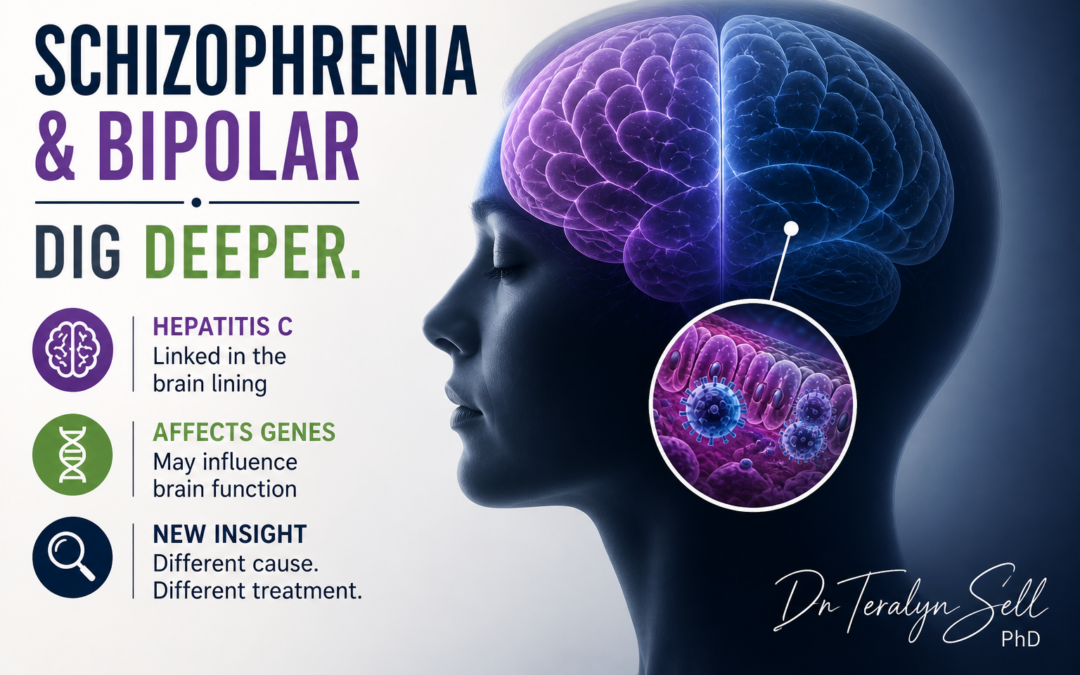
Mental health is often reduced to a diagnosis based on a cluster of symptoms. You meet criteria, you receive a label, and treatment follows. This model is efficient, but it is not complete. A research article examining the link between schizophrenia and Hepatitis C challenges this approach and forces a more careful evaluation of what may actually be driving psychiatric symptoms. The study found that Hepatitis C was present in the choroid plexus, the brain lining responsible for producing cerebrospinal fluid, in individuals with schizophrenia and bipolar disorder, but not in control groups or those with major depression. This is a critical distinction. The virus was not found in the brain tissue itself, yet it still appeared to influence brain function through changes in gene expression. This suggests that psychiatric symptoms may, in some cases, be influenced by biological factors outside of the traditional psychiatric framework.
This finding disrupts a common assumption in mental health. Schizophrenia is typically treated as a primary psychiatric disorder defined by symptoms such as hallucinations, disorganized thinking, and behavioral disruption. Once those symptoms are identified, the diagnosis is made, and treatment is directed toward symptom management. However, if an underlying infection such as Hepatitis C is present in a subset of individuals, then the diagnosis does not explain the cause. It only describes the presentation. This creates a gap in understanding. The presence of a virus affecting brain-related systems introduces a different pathway, one that moves beyond symptom classification and into biological contribution.
The core issue is how quickly the system moves from symptom to diagnosis without fully evaluating what may be driving those symptoms. This research highlights the importance of slowing that process down. If a virus can alter gene expression and influence brain function without directly infecting brain tissue, then symptoms may be downstream effects rather than the primary problem. This changes the clinical question. Instead of asking only what diagnosis fits, the more accurate question becomes what mechanisms are contributing to the presentation. This shift matters because it opens the door to different forms of evaluation and, in some cases, different treatment considerations.
The implications extend beyond this single study. Mental health does not exist in isolation from the rest of the body. Immune function, infection, inflammation, and environmental inputs all interact with brain function. When mental health is treated as a closed system, important contributors can be missed. This is where the limitation of symptom-based diagnosis becomes clear. Two individuals may receive the same diagnosis of schizophrenia, yet the underlying drivers of their symptoms may be entirely different. One may have a strong biological or infectious component, while another may not. Treating both as identical problems reduces precision and can limit outcomes.
This does not mean that all schizophrenia is caused by infection. The study does not make that claim. What it does show is that at least some cases involve factors that are not captured by traditional psychiatric models. That alone is enough to change how mental health should be approached. It introduces the need for broader evaluation and more careful interpretation of symptoms before conclusions are made. It also reinforces the idea that diagnoses are organizational tools, not explanations.
The risk of staying at the level of symptom clusters is that it can lead to incomplete understanding. When the focus remains on labeling rather than investigating, contributing factors may be overlooked. This can result in treatment that addresses surface-level symptoms while leaving underlying drivers unchanged. Over time, this shapes long-term outcomes. Not because the diagnosis was incorrect, but because it was treated as complete.
Mental health requires a deeper lens. Symptoms are real, but they are not the full story. Research linking schizophrenia and Hepatitis C underscores the need to move beyond fast conclusions and toward a more integrated understanding of how biology and behavior interact. The goal is not to abandon diagnosis, but to recognize its limits and avoid mistaking it for explanation.