
By Dr. Teralyn Sell, PhD
Clinically Reviewed by Dr. Teralyn Sell, PhD
Modern healthcare has become remarkably specialized. That has led to extraordinary expertise within individual disciplines, but it has also created an unintended consequence. The more specialized care becomes, the easier it is for the whole person to disappear.
This is true for children and adults alike.
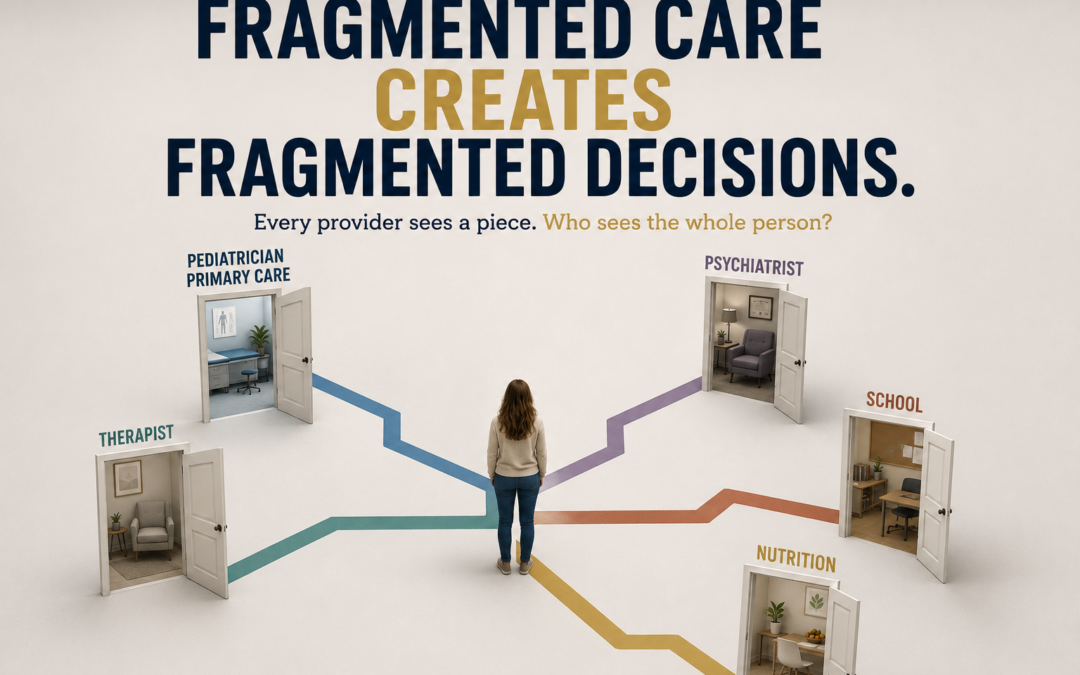
A pediatrician evaluates physical health. A therapist explores thoughts, emotions, and behavior. A psychiatrist considers diagnosis and medication. School professionals focus on learning and classroom performance. A neurologist looks at the brain. A gastroenterologist evaluates the gut. An endocrinologist manages hormones. Every clinician is trained to answer a specific set of questions.
But who is asking all of them?
Too often, no one.
Mental healthcare is increasingly delivered in silos. Providers may be highly skilled, yet they frequently work independently of one another. A therapist may never speak with the pediatrician. The pediatrician may never receive updates from the therapist. A psychiatrist outside a large healthcare system may have little or no communication with either of them. School professionals often develop their own understanding of the child without regular collaboration with medical providers.
Families are left to connect the dots.
Parents become the messenger between appointments, carrying records, repeating histories, and trying to reconcile recommendations that were never developed together. Adults find themselves doing the same, attempting to coordinate care between multiple specialists who may never have spoken to one another.
When care is fragmented, decisions become fragmented.
A clinician can only make decisions based on the information available to them. If important pieces of the picture are missing, even well-intentioned decisions are made with incomplete information.
One of the biggest missing pieces is nutrition.
Nutrition is rarely central to the mental health conversation despite its influence on brain development, energy, sleep, inflammation, metabolic health, and overall well-being. Has the child been eating enough protein? Are there nutritional deficiencies? Are blood sugar fluctuations affecting mood or attention? Is gastrointestinal health contributing to symptoms? Is appetite being affected by illness, stress, medication, or food insecurity?
These questions are often secondary, if they are asked at all.
The same can be said for sleep. Movement. Family dynamics. Chronic medical illness. Learning disabilities. Sensory processing differences. Developmental history. Environmental stress. Each may influence emotional and behavioral functioning, yet each is frequently evaluated separately instead of as part of one integrated picture.
This is not a criticism of individual clinicians.
It is a reflection of the system in which they work.
Most providers genuinely want the best for their patients. They are often constrained by brief appointments, limited reimbursement for collaboration, separate electronic medical records, privacy requirements, workforce shortages, and healthcare systems that reward productivity more than communication.
The result is predictable.
Excellent professionals can still produce fragmented care when they are working in isolation.
The future of mental healthcare should not be defined by one profession replacing another. It should be defined by better integration. Pediatricians, primary care clinicians, therapists, psychiatrists, nutrition professionals, occupational therapists, speech-language pathologists, schools, and families all contribute information that matters. None of them holds the entire picture alone.
Integrated care is not simply about having multiple professionals involved. It is about creating meaningful communication among them. It is about shared decision-making, repeated reassessment, and recognizing that understanding a person’s mental health requires more than a diagnosis or a symptom checklist.
Better decisions begin with better information.
And better information comes from seeing the whole person—not just the piece that happens to walk through one clinician’s door.