
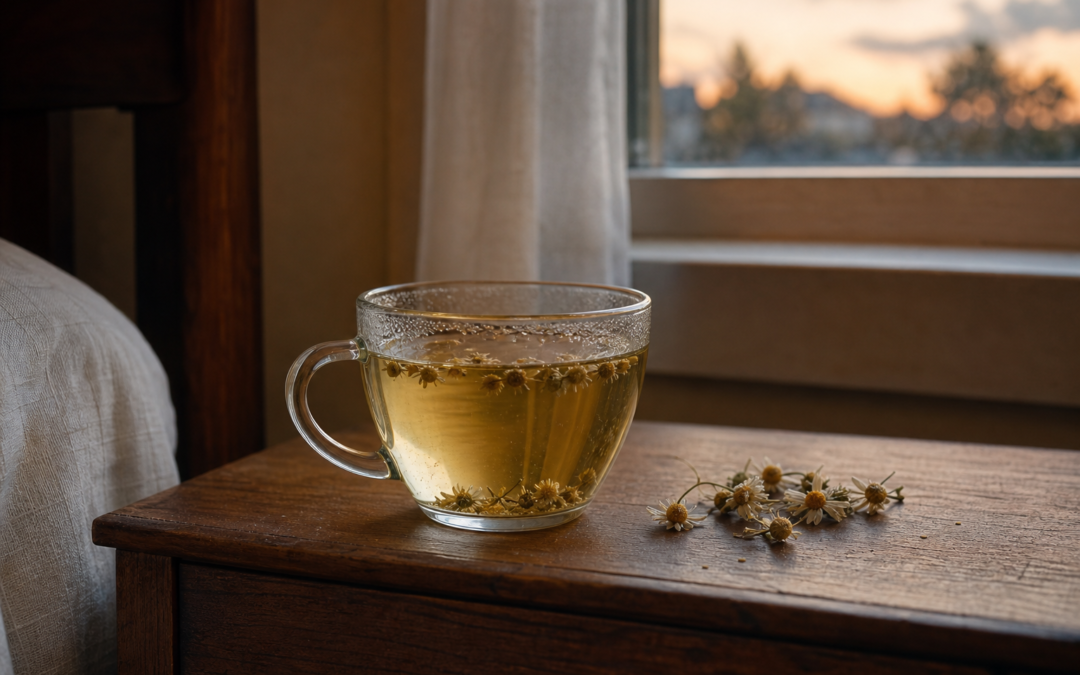
Chamomile has one of the most familiar reputations in the herbal world: a warm cup before bed, a quieter evening, better sleep.
That reputation is not baseless. It is also not as simple as it sounds.
“Chamomile” can mean a tea bag, loose dried flowers, a liquid extract, a capsule, or a combination product. Those are related preparations, but they are not interchangeable. When a study finds a result with one form, it does not automatically establish the same result for every form on a store shelf.
That distinction matters because chamomile often enters brain-health conversations through sleep. Sleep is relevant to attention, memory, learning, and day-to-day emotional regulation. But biological relevance is not the same thing as demonstrated improvement in those outcomes.
What the sleep evidence suggests
A 2024 systematic review and meta-analysis examined clinical trials of chamomile for sleep. Across five studies that could be pooled, participants reported better scores on the Pittsburgh Sleep Quality Index, a common questionnaire about perceived sleep quality.
That is worth noticing. It is not nothing.
But the same review found that chamomile did not clearly improve sleep duration, sleep efficiency, or measures of daytime functioning. Some studies suggested fewer awakenings or easier sleep onset. Others did not show changes in the outcomes people may care about most, such as how long they slept or how capable they felt the next day.
There was also substantial variation among the studies. Participants differed. Products differed. Study designs differed. Some research used extracts rather than an ordinary cup of tea. Several studies relied on self-reported sleep measures, which are useful but answer a different question than a sleep-lab measurement.
So the reasonable conclusion is narrower than the marketing version: chamomile may modestly improve some aspects of perceived sleep quality for some people. We do not yet have strong evidence that it reliably fixes insomnia, extends sleep, or improves daytime cognition.
A plausible mechanism is not the finish line
Chamomile contains compounds, including apigenin, that are frequently discussed in relation to brain signaling. That makes for an interesting hypothesis. It does not prove a clinical effect.
This is where supplement and herb conversations can drift too quickly from chemistry to certainty. A compound can bind to a receptor in a laboratory. A plant can have a long traditional history. A person can genuinely find a nightly tea comforting. All three can be true without proving that the preparation produces a consistent, clinically meaningful sleep outcome across people.
There is another practical issue: a tea ritual contains more than plant chemistry. It may replace late-evening alcohol, scrolling, work email, or another stimulating routine. That does not make the experience less real. It means we should be careful about assigning every observed benefit to chamomile itself.
Tea and extracts ask different questions
A simple chamomile tea is usually a less concentrated preparation than an extract or capsule, but “less concentrated” is not the same as predictable. The amount and composition of plant compounds can vary by species, growing conditions, processing, steeping, and product quality.
Extracts add another layer. They may be standardized to a particular constituent, but standardization does not establish that the chosen constituent is the whole story, nor does it guarantee that a capsule will reproduce the experience of tea. A capsule also removes the sensory and behavioral context of preparing and drinking something warm at the end of the day.
For readers comparing products, the useful question is not which form is strongest. It is: Which form was studied, at what dose and duration, in whom, and for what outcome?
That question also prevents a common leap from “a study used chamomile extract” to “any chamomile tea should work the same way.” We do not have grounds for that assumption.
Why this belongs in a brain-health conversation
Brain health is often discussed as though it lives inside a capsule. It does not. Sleep is one of the daily conditions that can affect alertness, attention, memory formation, and how mentally steady we feel. That makes questions about sleep-supporting habits relevant.
Still, sleep is not one outcome. Falling asleep, staying asleep, total sleep time, next-day fatigue, and perceived restfulness can move independently. Chamomile research is a useful reminder to ask which one was measured before deciding what a result means.
A person who says chamomile tea helps them unwind may be describing a real experience. A study showing a small shift in a sleep-quality score may also be real. Neither statement, on its own, means chamomile is a proven treatment for persistent sleep problems or a direct cognitive enhancer.
Before you add it
Chamomile has pharmacologic effects and may interact with prescription medications, over-the-counter medications, or medical conditions. Reported concerns include possible interaction with warfarin and other medicines processed by the liver; there are also theoretical concerns with sedatives. Evidence on many specific interactions is limited, so uncertainty is not the same as no risk.
Chamomile can trigger allergic reactions, particularly in people allergic to ragweed, chrysanthemums, marigolds, or daisies. Safety during pregnancy and breastfeeding is not well established. NCCIH also notes preliminary concerns regarding estrogen-sensitive conditions and hormonal contraceptives. Concentrated extracts deserve more caution than an occasional cup of tea because the preparation and exposure are different.
The better question is not whether chamomile is “good” or “bad” for sleep. It is whether the particular preparation, evidence, and safety context match the claim being made.
Written for Dr. Teralyn Sell, PhD
Psychology · Brain Health · Human Behavior
Sources worth knowing
- Effects of chamomile (Matricaria chamomilla L.) on sleep: A systematic review and meta-analysis of clinical trials
- Chamomile: Usefulness and Safety
- Therapeutic efficacy and safety of chamomile for state anxiety, generalized anxiety disorder, insomnia, and sleep quality: A systematic review and meta-analysis