
Written and reviewed by Teralyn Sell, PhD
Psychology | Brain Health | Psychiatric Medication Education
Aaron Carter died in November 2022 at just 34 years old. Nearly four years later, the legal questions surrounding his prescription medications are still being resolved.
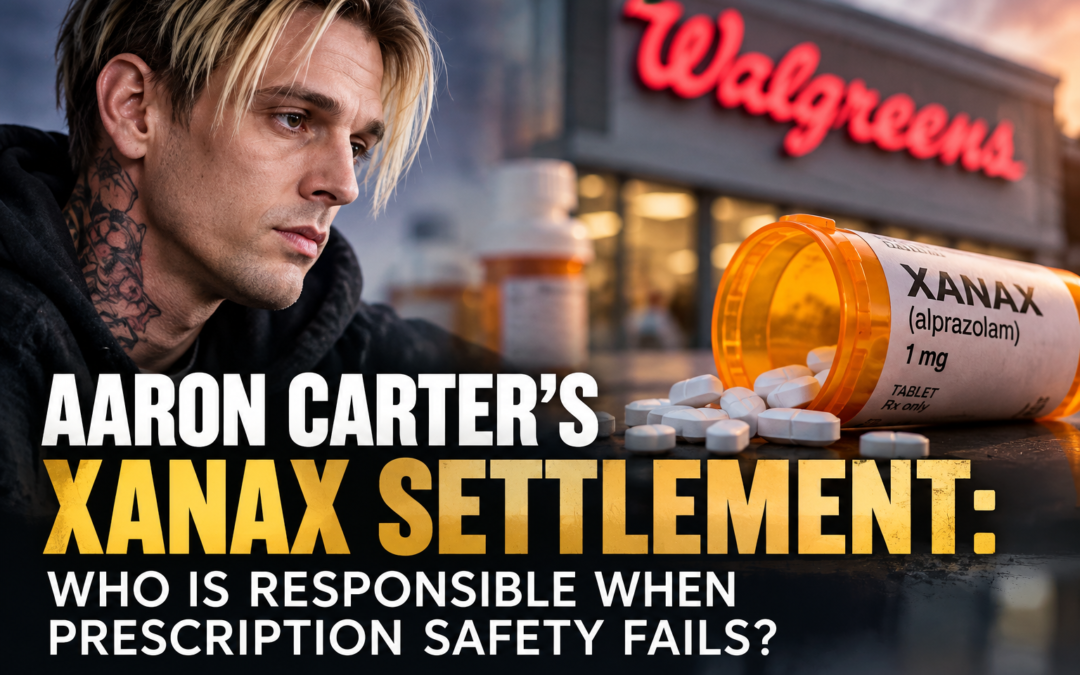
According to an October 2026 Rolling Stone report on Aaron Carter’s estate and Walgreens, Carter’s estate reached a confidential settlement with Walgreens and Santa Monica Medical Plaza Pharmacy in a wrongful-death lawsuit involving Xanax prescriptions. Earlier this year, the estate also settled claims involving a psychiatrist and his practice. Claims against Carter’s former dentist remain pending.
The lawsuit alleged that medical professionals and pharmacies supplied Carter with excessive quantities of Xanax despite concerns about his medication use. Those allegations have not been established as facts by a court, and settlement does not automatically mean an admission of wrongdoing.
But here’s the question I keep coming back to: How many professionals can be involved in someone’s medication care before we stop assuming that somebody else is watching the whole picture?
This isn’t simply a story about a celebrity, a prescription, or a lawsuit. It’s about informed consent, medication oversight, and what happens when the healthcare system treats prescribing and dispensing as separate transactions rather than parts of an ongoing responsibility.
What Happened in Aaron Carter’s Xanax Lawsuit?
Carter was found dead in a bathtub at his California home on November 5, 2022. The Los Angeles County Medical Examiner determined that he died from drowning due to the effects of difluoroethane, a chemical found in some compressed-gas products, and alprazolam, the generic name for Xanax. His death was classified as accidental.
That distinction matters. Xanax was one of the substances identified in the medical examiner’s findings, but it would be inaccurate to say that Xanax alone caused his death.
The wrongful-death lawsuit, filed on behalf of Carter’s son, alleged that prescribers and pharmacies provided excessive amounts of alprazolam and failed to adequately respond to the risks. In October 2026, the estate resolved its claims against two pharmacies. The settlement terms were not disclosed, and the remaining claims against a former dentist were still pending at the time of reporting.
The case raises broader questions about what constitutes adequate medication monitoring, particularly when multiple professionals may be involved in a patient’s care.
And those questions don’t disappear simply because a prescription was written by a licensed professional or filled by a licensed pharmacy.
A Prescription Is Not a Guarantee of Safety
Xanax belongs to a class of medications called benzodiazepines, which are prescribed for conditions including anxiety and panic disorder. These medications can provide symptom relief, but they also carry significant risks.
In September 2020, the U.S. Food and Drug Administration strengthened its boxed warnings for benzodiazepines to address misuse, addiction, physical dependence, and withdrawal reactions. The FDA’s benzodiazepine safety communication specifically explains that physical dependence can develop even when someone takes these medications exactly as prescribed.
That’s an important distinction, because physical dependence and addiction are not interchangeable terms.
Physical dependence occurs when the nervous system adapts to repeated exposure to a medication. If the medication is suddenly stopped or reduced too quickly, withdrawal symptoms can occur. Addiction involves a different pattern of impaired control over substance use despite harmful consequences.
A person can become physically dependent on a benzodiazepine without having an addiction.
Yet these concepts are frequently confused, even in conversations about psychiatric medication safety.
Patients deserve to understand that taking a medication exactly as prescribed does not eliminate the possibility of dependence, adverse effects, or potentially dangerous interactions.
Who Is Looking at the Entire Medication Picture?
One of the most troubling questions raised by prescription-safety lawsuits is how responsibility is distributed among prescribers, pharmacists, and other healthcare professionals.
Imagine a patient seeing several providers. One prescribes medication for anxiety. Another addresses pain. Someone else treats a sleep problem. Each professional may be attempting to help with a legitimate concern.
But who is reviewing everything together?
Who is considering cumulative sedation, medication interactions, changes in functioning, or whether the original reasons for prescribing a medication still apply?
Pharmacists have an important role in reviewing prescriptions for safety concerns, and prescribers are responsible for evaluating treatment risks and benefits. But the existence of those professional responsibilities doesn’t guarantee that communication between providers is seamless.
This is especially important with benzodiazepines because combining them with opioids, alcohol, or other central nervous system depressants can increase the risk of dangerous sedation, breathing problems, and death.
The point isn’t that every medication combination is inappropriate. It’s that medication safety requires an understanding of the patient’s complete circumstances, not just an individual prescription.
And patients should not be expected to independently identify every pharmacological risk that trained professionals are supposed to evaluate.
Informed Consent Should Be More Than a Warning Label
We talk about informed consent as though it’s a single conversation that happens before treatment begins.
But medication decisions aren’t frozen in time.
A prescription that appeared reasonable when treatment started may need to be reconsidered months or years later. A patient’s health may change. Other medications may be added. Side effects may emerge. The original symptoms may improve, worsen, or become difficult to distinguish from medication-related effects.
Meaningful informed consent should include an understandable discussion of expected benefits, known risks, reasonable alternatives, and what happens if someone eventually wants to discontinue the medication.
It should also be revisited.
For benzodiazepines, that means explaining the possibility of physical dependence and withdrawal before someone has spent months or years taking the medication.
It also means discussing the risks of combining sedating substances and identifying symptoms that warrant medical attention.
Being informed enough to agree to a prescription is not necessarily the same as being informed enough to manage its long-term consequences.
That difference matters.
What About Patients Who Are Already Dependent on Xanax?
Here’s another uncomfortable reality.
Recognizing the risks of long-term benzodiazepine use doesn’t mean abruptly stopping the medication is safe.
In fact, the FDA warns that suddenly discontinuing benzodiazepines or reducing the dose too quickly can cause severe withdrawal reactions, including potentially life-threatening seizures.
The 2025 Joint Clinical Practice Guideline on Benzodiazepine Tapering, developed through a multidisciplinary effort led by the American Society of Addiction Medicine, emphasizes individualized decision-making, gradual reductions when indicated, and ongoing monitoring.
This creates a difficult situation for some patients. They may be concerned about the risks of continuing a medication while also facing significant risks from discontinuing it too quickly.
Both concerns deserve to be taken seriously.
Medication safety doesn’t end when someone decides to stop taking a drug. Safe discontinuation, when appropriate, is part of the responsibility of medication management.
And the decision should be made collaboratively with a qualified prescriber rather than through abrupt changes made without medical oversight.
Why Do We Wait Until Something Goes Wrong?
One of the most frustrating patterns in healthcare is how often serious questions emerge only after a tragedy.
A lawsuit is filed. Medical records are reviewed. Prescription histories are examined. Experts debate whether warning signs should have been recognized.
But what about the people who are still taking these medications today?
How many have had a recent review of their entire medication regimen? How many understand the distinction between dependence and addiction? How many know what withdrawal can look like or whether the medication they’re taking is still the most appropriate option for them?
And how many are afraid to ask questions because they worry they’ll be labeled difficult, noncompliant, or drug-seeking?
Patients shouldn’t have to wait for something to go wrong before their concerns are taken seriously.
That’s one reason I emphasize education and informed decision-making in my work around psychiatric medication and deprescribing. Understanding the benefits, risks, and limitations of medication treatment gives people a stronger foundation for conversations with their prescribers.
The goal isn’t to convince everyone to take psychiatric medication or to convince everyone to stop.
It’s to make sure people understand the decisions they’re being asked to make.
The Bigger Lesson From Aaron Carter’s Case
Aaron Carter’s death was tragic. The legal proceedings that followed have raised important questions about prescription oversight, but they do not establish that every allegation in the lawsuit was true.
We should be careful about assigning blame without evidence.
We should be equally careful about dismissing legitimate medication-safety questions simply because a prescription was legally written and dispensed.
Benzodiazepines can provide meaningful benefits. They can also produce physical dependence, withdrawal difficulties, sedation, and dangerous interactions. Those realities are not mutually exclusive.
And here’s the question worth asking long before another lawsuit makes headlines:
If several professionals are involved in prescribing and dispensing a medication, who is making sure the entire treatment plan still makes sense?
Because filling a prescription is a transaction.
Protecting a patient requires ongoing attention.
References and further reading
Rolling Stone: Aaron Carter Estate Reaches Settlement With Walgreens Over Xanax Prescriptions (October 2026).
Rolling Stone: Aaron Carter’s Family Reaches Settlement With Psychiatry Clinic Over Xanax Prescriptions (May 2026).
Joint Clinical Practice Guideline on Benzodiazepine Tapering (2025).
Educational disclaimer: This article provides general information about psychiatric medications and patient safety. It is not psychotherapy, medical treatment, diagnosis, or individualized medication advice. Do not abruptly discontinue benzodiazepines. Medication changes should be discussed with an appropriately qualified prescribing professional.