
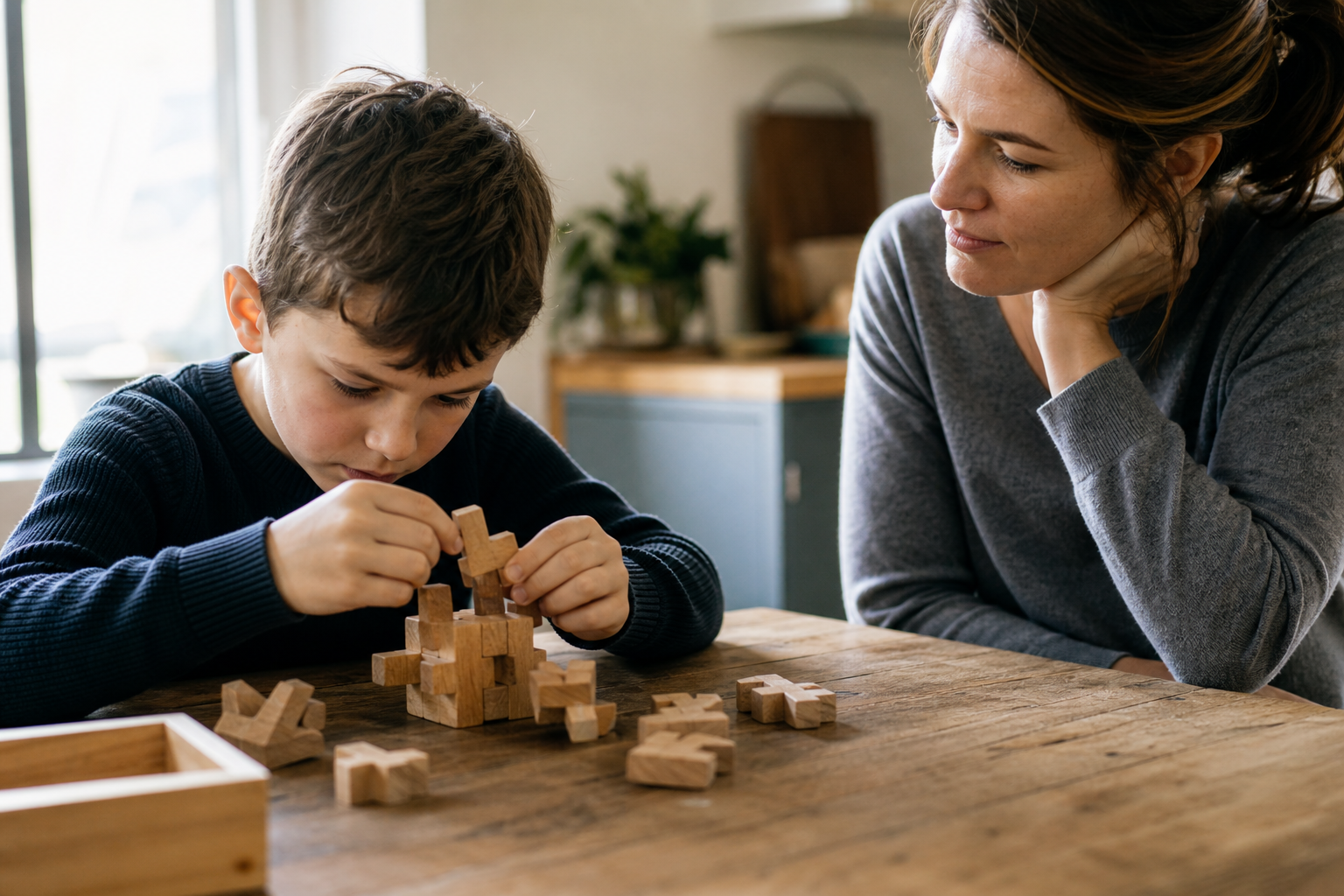
“You’re so smart.” It rolls off the tongue when a child brings home a great test score, finishes a tricky puzzle, or says something unexpectedly clever.
It sounds like the safest kind of encouragement. Who wouldn’t want a child to feel capable?
But I wondered about the moment after that one. What happens when the same child gets stuck, gets corrected, or meets a problem they can’t solve quickly? Does being praised as smart make a hard task feel like an invitation to learn, or like a referendum on whether they are, in fact, smart?
That’s a much more interesting question than whether praise is “good.” Praise can be warm, sincere, and deserved. The real issue is whether it changes what a child thinks a setback means.
The compliment that can become a test
In a widely discussed 1998 series of experiments by Claudia Mueller and Carol Dweck, fifth graders completed problems, received different kinds of praise, and then faced more difficult work. Some were praised for intelligence. Others were praised for effort.
The children praised for intelligence were more likely to choose easier subsequent problems, and after struggling they showed less persistence and enjoyment than children praised for effort. The point wasn’t that intelligence is imaginary or that children should never hear a positive word about their abilities. It was that a message like “you’re smart” can make performance carry a larger burden.
If success confirms that I’m smart, failure may seem to reveal that I’m not.
And once a task feels like an identity test, the sensible move may be to avoid the task. Not because the child is lazy. Not because they don’t care. Because trying, openly and unsuccessfully, has become expensive.
That has consequences beyond school. A child who protects the image of being naturally good at something may be less inclined to attempt the awkward early stages of learning: the bad first drawing, the missed shot, the wrong answer, the halting first conversation in another language. Those stages are where people learn how to learn.
What are we praising, exactly?
There’s a meaningful difference between saying, “You’re a natural,” and noticing something concrete: the strategy a child used, the revision they made, the patience required, or the fact that they asked a better question after getting something wrong.
The first statement describes a person. The second describes an action in the world.
That distinction may sound fussy until the child encounters a limit. “You’re brilliant” doesn’t offer much information about what to do next when the answer doesn’t come. “You kept changing your approach when the first one didn’t work” at least names something repeatable.
A 2013 observational study followed families over time and found that toddlers who heard more process-focused praise from parents, language focused on effort, actions, and strategies, later showed more adaptive beliefs about challenge. But this was not an experiment that assigned parents to speak in one way or another. It can’t tell us that praise alone produced those later differences. Families bring whole worlds with them: stress, resources, expectations, conversation styles, schools, siblings, and opportunities to practice hard things.
Still, the study points toward a useful possibility. Children are listening not only for whether adults approve of them, but for what adults seem to think success means.
The parenting rule got too simple
This is where the internet tends to make a mess of a decent idea.
“Praise effort, not ability” became a rule. Then “growth mindset” became a kind of verbal garnish sprinkled over every disappointing result. A child could produce almost nothing, hear “great effort,” and learn that adults will say encouraging things whether the feedback is specific or useful.
That isn’t what good feedback is for.
Effort matters, but effort by itself isn’t always the relevant accomplishment. Someone can work very hard using an unhelpful strategy. Sometimes the most useful thing a child did was slow down, ask for help, start again, tolerate being a beginner, or realize that the task was pitched wrong. Sometimes they succeeded because they already knew a lot. Reality is allowed to be part of the conversation.
And the research doesn’t support treating one sentence as a magic switch. A 2024 preregistered experiment with children completing online puzzles found no difference in persistence after failure between children who received person praise and those who received process praise. Process praise did lead to more persistence than a neutral control condition in exploratory analyses, but the cleaner comparison between the two praise styles was not significant.
That’s not a reason to throw out the earlier work. It’s a reason to keep the question open. Context matters. Age may matter. Culture may matter. So may the relationship between the adult and child, whether the praise is credible, what task is involved, and whether the child has a history of being valued mainly for performance.
The larger “mindset” literature carries a similar caution. A meta-analysis of mindset research found overall effects on academic achievement were weak, even though some students, including those facing academic risk, may benefit more than others. That is a far cry from saying a better compliment reliably changes a child’s future.
What praise can’t do for us
Parents and teachers are often handed a strange burden: say the right thing and you can protect a child from self-doubt, disengagement, or disappointment.
That’s too much weight to put on a sentence.
Children don’t become willing to face difficulty because adults have found the perfect wording. They learn from the repeated experience of being allowed to struggle, being taken seriously when something is hard, receiving information they can use, and discovering that one disappointing performance does not settle the question of who they are.
So perhaps the better question isn’t, “Am I praising this child correctly?” It’s this: when things don’t go well, what story is the child being invited to tell about the setback?
A story about being gifted or not gifted can make the world very small. A story about paying attention, trying something different, and deciding what is worth another attempt leaves more room for a child to think, choose, and stay engaged with a difficult life.