
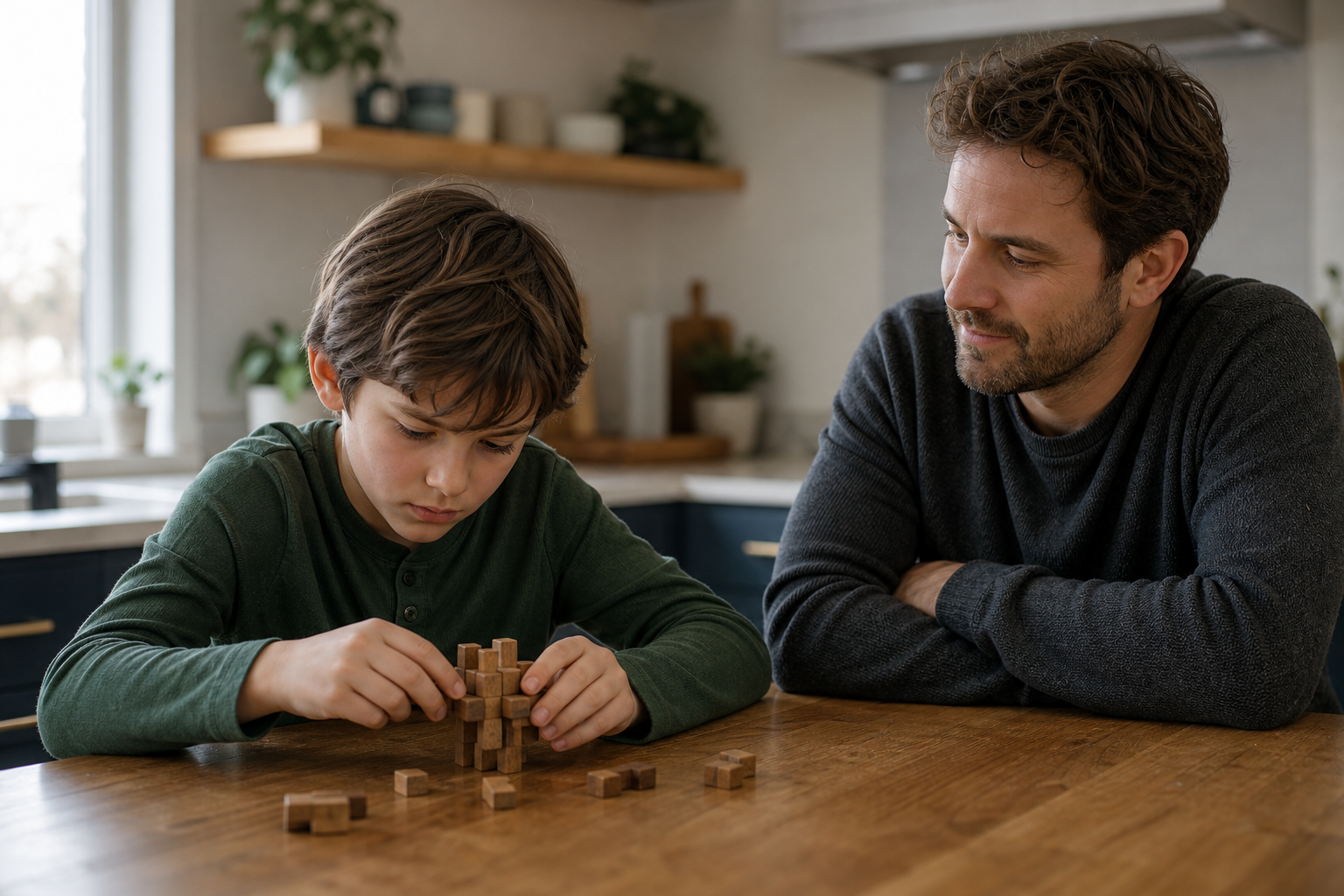
“You’re so smart.”
It’s one of those sentences many of us say almost automatically. A child brings home a good grade, figures out a puzzle, remembers an obscure dinosaur fact, and there it is. The compliment feels warm, deserved, and harmless.
But I’ve wondered about what happens next.
Not when the child succeeds again. When the next assignment is confusing. When the puzzle won’t come together. When they try something in front of other people and aren’t immediately good at it.
Does praise help a child meet that moment? Or can some kinds of praise quietly make failure feel like a verdict on who they are?
The praise is not the whole story
People often talk about praise as though it has one effect: more praise equals more confidence. That’s too simple.
In a well-known series of experiments, fifth graders first completed problems successfully and then received praise focused either on intelligence or effort. Afterward, they faced more difficult problems. Children praised for intelligence showed less persistence and enjoyment after failure, and their subsequent performance suffered relative to children praised for effort. The researchers’ point was not that encouragement is bad. It was that the meaning a child takes from encouragement can matter when things stop going well. You can read the original 1998 study by Claudia Mueller and Carol Dweck.
“You’re smart” may land as more than a description of one good performance. It can suggest that being smart is the thing to protect.
If that’s the hidden assignment, an unfamiliar challenge becomes risky. Getting it wrong may no longer mean, “I don’t understand this yet.” It may feel closer to, “Maybe I’m not the kind of person everyone thought I was.”
That’s a very different problem to solve.
Why “praise effort” became the rule
Out of findings like these came a popular parenting and education rule: praise effort, not ability.
There’s something sensible in it. Process-focused comments can point to what a child did: the strategy they tried, the revision they made, the way they stayed with something. Those are parts of learning a child can observe and revisit. They offer information, not just a rating.
And that distinction matters in real life. A child who can think, “That approach didn’t work, so I need another one,” has more room to keep working than a child who concludes, “I failed because I’m not good at this.” The outcome I care about isn’t whether a child can repeat the phrase “growth mindset.” It’s whether they can tolerate being a beginner long enough to learn something.
Still, the popular rule hardened too quickly. “Effort praise” is not a magic phrase, and repeating “you worked so hard” after every outcome can become another kind of performance script.
Imagine putting hours into a project that still goes badly. An adult says, “But you tried your best!” Sometimes that may feel seen. Other times, it may sound like a polite way of saying there’s nothing more to discuss. What did the child learn? What part was difficult? Was the goal realistic? What would they want to try differently? Praise can’t replace curiosity about the work itself.
Here’s where the tidy story gets messier
A broad review of research on praise and intrinsic motivation reached a much less slogan-friendly conclusion. Praise may help, hurt, or have little effect depending on whether it seems sincere, supports a sense of competence and autonomy, avoids heavy social comparison, and makes the standard for success understandable and attainable.
That makes intuitive sense. “You’re the best one in the class” does not merely notice a child’s work. It places the child in a contest. “You found a different way to organize those ideas” does something else. It names something that happened without requiring the child to become permanently impressive.
Age, culture, the task, a child’s prior experiences, and who delivers the feedback may all change the picture. Children are not identical receivers of carefully engineered sentences.
And some newer research challenges the cleanest version of the classic finding. In a preregistered 2024 experiment, children who received process praise did not differ from children who received person praise on the study’s primary measures of persistence or self-evaluation after a later failure. Process praise did show greater persistence than a control condition in exploratory analyses. The authors concluded that adult feedback may be more context-dependent than the usual simple contrast implies. That study of praise and “easy” feedback is a useful reminder not to turn a research finding into parenting folklore.
The same caution applies to observational work. Researchers who recorded parents interacting with children between ages one and three found that a higher proportion of process praise predicted more adaptive motivational beliefs years later. Interesting? Yes. Proof that a particular sentence caused the later outcome? No. Families bring many things to those conversations that a recording cannot fully capture. The longitudinal study can tell us that everyday language may be part of a larger developmental pattern. It cannot reduce a child’s future to a praise ratio.
Maybe the better question is not “Was I positive?”
I don’t think the lesson here is to become guarded around children, withholding delight lest we accidentally damage their motivation. That would miss the point entirely.
Children deserve to hear joy, appreciation, and genuine admiration. They also deserve adults who don’t need them to be exceptional every minute.
The more revealing question may be: what is this child learning that success and failure mean?
Are they learning that a mistake is evidence about their worth? Are they learning that hard work guarantees a good result, which life will eventually disprove? Or are they getting better at noticing a problem, revising a plan, asking for help, deciding when to persist, and recovering enough curiosity to take another look?
Those abilities matter far beyond school. They shape whether someone can enter a new job without needing instant mastery, make room for feedback in a relationship, or keep thinking when the first answer turns out to be wrong.
So perhaps praise is not mainly about making children feel good in a particular moment. Perhaps it is one small part of teaching them that they can be valued, engaged, and interested in the work even when the outcome is unfinished.