
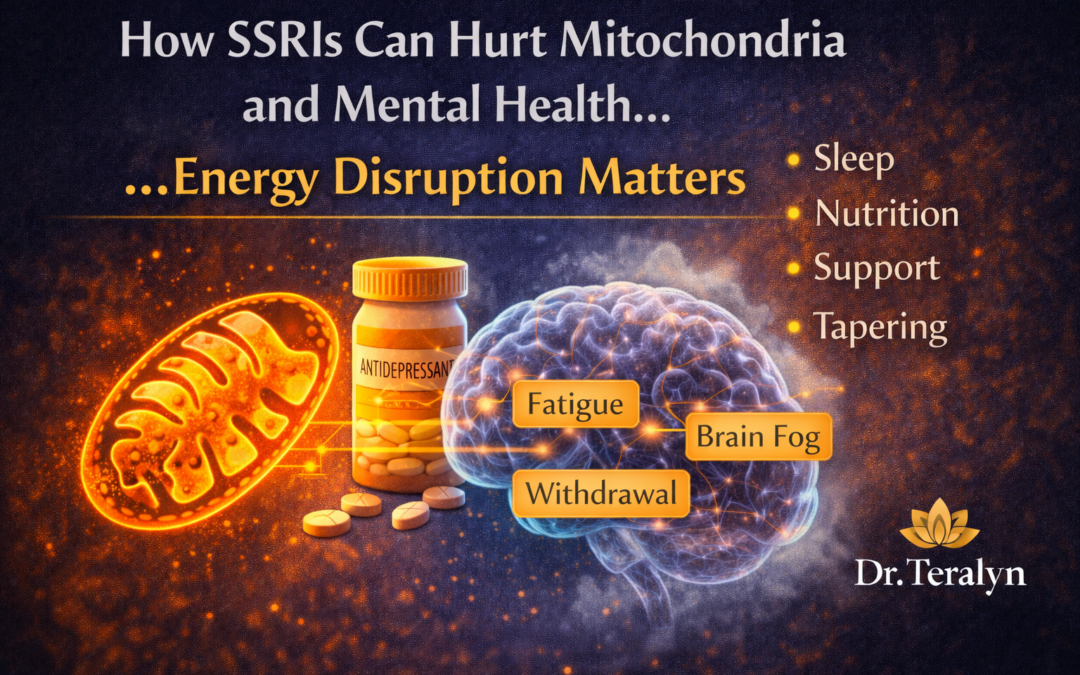
SSRIs are commonly described as medications that “fix” serotonin levels in the brain. What is talked about far less is how SSRIs affect the brain’s energy system. Mitochondria are the parts of cells that make energy, and the brain depends on them more than any other organ. When mitochondria struggle, mental health struggles often follow. This connection matters, especially for people who feel worse over time on SSRIs or have difficulty coming off them.
Research shows that SSRIs can interfere with mitochondrial function in several ways. Mitochondria rely on complex chemical steps to produce energy. SSRIs can disrupt these steps, increase oxidative stress, and reduce how efficiently mitochondria produce energy. This does not happen overnight. It develops gradually, which is why many people feel “okay” at first but slowly notice fatigue, emotional flattening, brain fog, or reduced motivation over time.
When mitochondrial energy drops, the brain compensates by conserving resources. Emotions may feel muted. Thinking may slow down. Stress tolerance shrinks. This is often interpreted as depression, anxiety, or relapse, even though it may be a sign that the brain is running on low power. Increasing the SSRI dose in this situation may further strain energy systems rather than solve the problem.
This helps explain why some people feel exhausted, unmotivated, or cognitively dulled on SSRIs. It also explains why therapy can feel harder while on these medications. Therapy requires energy. Insight, emotional regulation, and behavior change all require a brain that can generate enough power. When mitochondria are under strain, people may feel stuck and blame themselves for not improving.
The mitochondrial impact of SSRIs also matters during deprescribing. When an SSRI is reduced, the brain must adapt again. Neurotransmitter systems recalibrate, stress hormones shift, and energy demand increases. If mitochondria are already compromised, withdrawal can feel overwhelming. Symptoms like anxiety, insomnia, agitation, brain fog, and mood swings are often labeled as relapse, when they may actually reflect an energy-starved brain trying to rebalance.
This is why tapering SSRIs is not just a psychological process. It is a biological one. A brain with limited energy has fewer options. It reacts faster, louder, and with less flexibility. Supporting mitochondrial health during deprescribing can reduce symptom intensity and help people tolerate change without panic.
This does not mean SSRIs are always wrong or harmful. They can be helpful for some people, especially short term. But long-term use comes with trade-offs that are rarely explained. One of those trade-offs is energy. People are often told SSRIs are correcting a chemical imbalance, when in reality they may also be increasing biological strain over time.
Supporting mitochondria during SSRI use or tapering means focusing on fundamentals. Sleep becomes non-negotiable because mitochondria repair during rest. Nutrition matters because mitochondria need fuel and nutrients to make energy. Stable blood sugar reduces unnecessary energy drain. Gentle movement strengthens mitochondrial efficiency. Reducing inflammation and overall stress load allows the brain to recover capacity.
Deprescribing works best when fear is reduced and biology is supported. When people understand that symptoms during tapering may reflect mitochondrial strain rather than relapse, they make better decisions. They pace differently. They stop interpreting every sensation as danger. Judgment improves.
Mental health is not just about serotonin. It is about energy. When SSRIs affect mitochondrial function, mental health outcomes change—sometimes quietly, sometimes dramatically. Ignoring this link leaves people confused, mislabeled, and stuck on medications longer than intended.
Understanding mitochondria restores clarity. And clarity is essential for safe, informed deprescribing.
Medically reviewed by Dr. Teralyn Sell, PhD