
By Dr. Teralyn Sell, PhD
Clinically Reviewed by Dr. Teralyn Sell, PhD
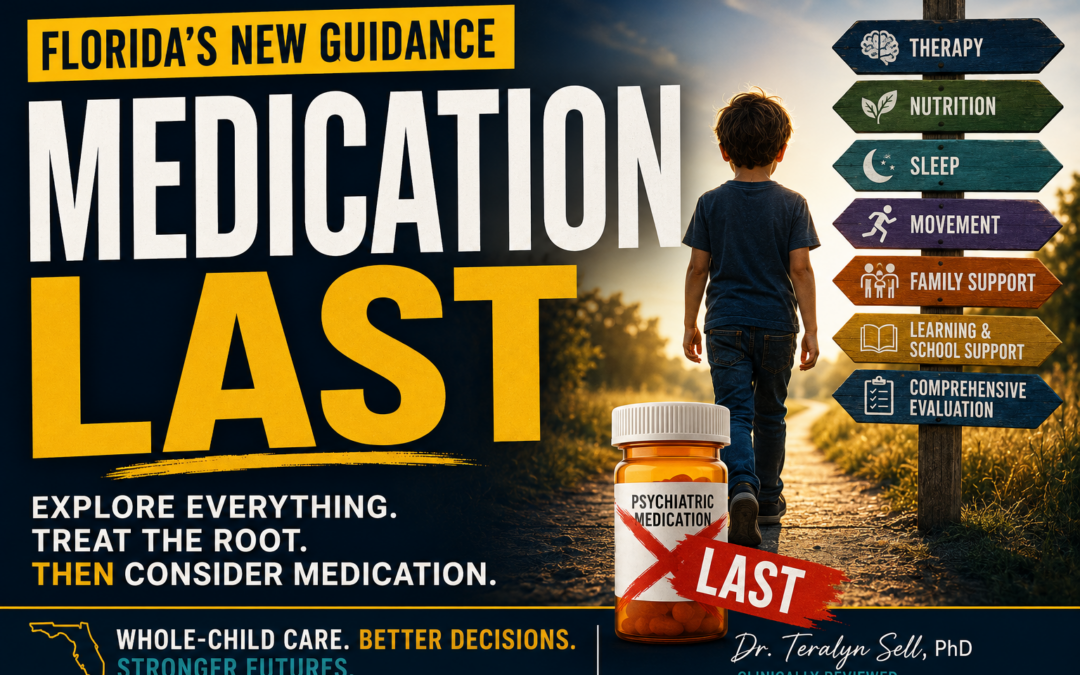
Florida has issued new guidance recommending that most children with depression, anxiety, ADHD, and behavioral concerns should not receive psychiatric medication as the first intervention. Instead, the state is encouraging providers to begin with comprehensive evaluations, psychotherapy, behavioral interventions, and an assessment of factors such as sleep, nutrition, physical activity, family stress, and environmental influences before considering medication. Importantly, this guidance is advisory rather than legally binding, and medication remains an option when clinicians determine it is medically appropriate.
I believe this is an important shift.
For years, many families have experienced a system in which medication often became the first conversation rather than the last. When a child is struggling, parents deserve more than a prescription. They deserve a careful evaluation of the whole child. They deserve to understand what may be contributing to the symptoms before concluding that medication is the only path forward.
That does not make this an anti-medication position.
There are children for whom psychiatric medication may become an appropriate part of treatment (we still don’t have a great way to assess this). The key issue is sequence. Before introducing a medication that may be taken for months or years, clinicians should understand the child’s biology, psychology, family environment, school experience, developmental history, medical conditions, and daily habits. Those factors frequently interact in ways that cannot be captured during a brief office visit.
Where I believe the conversation now needs to go is beyond simply recommending therapy and lifestyle first.
Therapy alone is not enough. LIfestyle alone isn’t either.
If we are serious about understanding the root causes of emotional and behavioral difficulties, then we need to build systems capable of doing exactly that. A child struggling with anxiety or attention problems may also have untreated sleep disturbances, nutritional deficiencies, learning disabilities, chronic medical illness, bullying, family conflict, sensory differences, trauma exposure, excessive screen time, or significant academic stress. None of those issues are solved by medication alone, and none are fully addressed by therapy in isolation.
That requires a treatment team.
It also requires something that is often overlooked: time.
Lifestyle interventions are not prescriptions that produce immediate results. Heck, prescriptions don’t even produce immediate responses. Improving sleep habits, addressing nutritional deficiencies, increasing physical activity, reducing family stress, modifying school supports, strengthening parenting strategies, or treating underlying medical conditions all require consistent follow-up. Progress must be monitored. Plans need to be adjusted. Families need education, encouragement, and access to professionals who can help them navigate obstacles along the way. A comprehensive evaluation is only the beginning. Meaningful change occurs through ongoing care, repeated reassessment, and sustained collaboration.
Imagine what pediatric mental healthcare could look like if families had coordinated access to a pediatrician, therapist, school professionals, nutrition expertise when appropriate, occupational or speech therapy when indicated, and thoughtful psychiatric consultation when medication is being considered. Each professional contributes a different piece of the puzzle. No single discipline has the complete picture.
Unfortunately, that is not the current standard of care.
In reality, many families struggle to find a child therapist at all. Insurance networks are limited. Wait lists stretch for months. School resources are overwhelmed. Nutrition services, occupational therapy, behavioral supports, and developmental specialists are often difficult to access or financially out of reach. Pediatricians frequently have little choice but to make decisions during short appointments while managing a growing mental health crisis. Even clinicians who value comprehensive care often work within systems that make it extraordinarily difficult to deliver.
That is why recommendations alone are not enough.
If we encourage therapy, lifestyle interventions, and comprehensive assessments before medication, we must also build the infrastructure to support those recommendations. That means giving families access not only to the initial evaluation but also to the months of follow-up care required to implement meaningful change. Without that investment, lifestyle recommendations risk becoming little more than words on paper rather than interventions that have a genuine opportunity to succeed.
This discussion should not become another battle between medication and non-medication care. That is far too simplistic. The real goal should be better decision-making. Every child deserves an individualized assessment, thoughtful informed consent, and a treatment plan that reflects their unique circumstances rather than a one-size-fits-all approach.
Florida’s guidance opens an important conversation. Whether it changes outcomes will depend not only on what is recommended, but on whether families are given access to the multidisciplinary care—and the ongoing follow-up—that those recommendations require. Until comprehensive, team-based pediatric mental healthcare becomes the norm rather than the exception, recommendations will remain ahead of the systems needed to support them. That is the challenge we should be working to solve.