
teralyn sell, phd | brain health + human performance
You’re Performing. Here’s what it’s costing you.
You’re successful, and you’re getting things done. The Human Reserve Lab is a deeper look at what’s supporting your capacity, what’s drawing on it, and how much you have left, so you can keep performing without running yourself down.
For anyone whose work demands more than most people ever see, and who’s starting to feel the cost.
Executives · Founders · Physicians · Athletes · Military · First Responders · and anyone carrying a lot
teralyn sell, phd | brain health + performance
You’re Performing. But at What Cost?
You’re successful, and you’re getting things done. The Human Reserve Lab is a deeper look at what’s supporting your capacity, what’s drawing on it, and how much you have left, so you can keep performing without running yourself down.
For anyone whose work demands more than most people ever see, and who’s starting to feel the cost.
Executives · Founders · Physicians · Athletes · Military · First Responders · and anyone carrying a lot
Trusted by physicians & clinicians for brain health guidance. Featured in






Technically, you’re functioning.
But there’s a difference between getting through life and having the capacity to fully participate in it.
You’re still delivering.
But it takes more than it used to. The output is there, and the reserve behind it is getting thinner.
Recovery isn’t working like it used to.
Sleep, time off, and weekends don’t restore you the way they once did.
Every decision costs more.
Work. People. Information. Responsibility. You can handle it, but what is it costing you?
Nothing is necessarily wrong. You just know there’s more in you.
Your energy. Your focus. Your edge. You want to understand what actually makes a difference.
THE COST OF KEEPING UP
What have you started accepting as normal?
You’re the person everyone counts on. The deadlines get met. The bills get paid. You always find a way.
But lately, you sit in the driveway a little longer before going inside. You reread emails. Reach for another coffee. Promise yourself you’ll catch up on sleep this weekend.
Maybe you’ve even started taking a psychiatric medication to help manage it all.
And because you’re still functioning, nobody questions it.
But the people you love are getting what's left of you. And so are you.
That’s why I created Human Reserve.
To help you understand why the life you’ve worked so hard to build is taking so much out of you. We examine your brain health, the demands you’re carrying, and what may have been overlooked.
You didn’t work this hard to build a life you’re too depleted to enjoy.
What are we actually trying to protect?
Because what’s the point of getting through the day if there’s nothing left of you to enjoy it?
Think.
Clarity, memory, focus, and the ability to learn.
Work.
Contribute, solve problems, and do work that matters.
Connect.
Relationships, belonging, and engagement with others.
Create.
Ideas, curiosity, imagination and possibility.
Decide.
Judgment, agency and the ability to navigate uncertainty.
Participate.
The energy and capacity to show up fully in your own life.
This is Human Capacity.
Not simply whether you can function, but how much of you is available to think, connect, create, decide, work and participate.
THE STORY BEHIND HUMAN RESERVE
I know what it means to look fine on paper.
I was so good at performing that even my husband couldn’t tell when I was struggling.
He would say, “I didn’t know you were struggling, because you make things look easy.”
I’ve always been a Type A high performer. Driven, ambitious, and accustomed to carrying more than most people could see.
I was successful, productive, and meeting expectations. But my own experience with psychiatric medication taught me that functioning and being well are not the same thing. What was supposed to help left me feeling emotionally numb, physically unwell, and increasingly disconnected from the life I was working so hard to build.
Over 25 years of clinical work, I’ve seen the same pattern in others. Capable people doing everything expected of them, with little left at the end of the day.
It changed the questions I asked. Not just “Are you functioning?” but “What is it costing you, and what are we overlooking?”
That’s why I created Human Reserve, an approach that brings psychology, brain health, and human performance together to examine what supports your capacity, what depletes it, and what allows you to sustain it.
Today, I work with driven individuals, professionals, and high performers who want to understand not just how to perform, but how to sustain their performance without sacrificing their health or the rest of their lives.
Because the real measure of performance isn’t how much you can carry. It’s how much of yourself you have left after carrying it.

ways to work with me
There’s more than one way to build capacity.
⊕ HUMAN RESERVE LAB
Understand what’s taking so much out of you.
Take a deeper look at your brain health, the demands on your capacity, and the factors that may have been overlooked.
EXPLORE THE LAB ➜
◎ HUMAN PERFORMANCE
Show up ready when it matters.
Develop the focus, confidence, adaptability, and mental skills to perform under pressure without sacrificing yourself in the process.
EXPLORE PERFORMANCE ➜
☼ CAPACITY FOUNDATIONS
Give your brain what it needs.
Build the foundations of brain health through nutrition and daily habits that support energy, clarity, and long-term capacity.
BUILD YOUR FOUNDATION ➜
◇ MEDICATION DECISIONS
Is your medication still serving you?
Understand the benefits, risks, and trade-offs of psychiatric medication. Explore your options, including whether a carefully planned taper may be appropriate, with informed consent at the center.
EXPLORE MEDICATION DECISIONS ➜
In their words
What it’s like to work together.
Love Dr Teralyn! I appreciate her knowledge, alternative approaches to mental health care, ability to make health care relatable, and her authenticity!
Tracy M.
Dr. Sell is the best! Her authenticity & passion shines boldly through all her work.
She’s everything you would want in a holistic health provider!
Ally H.
Dr. Sell is one of the best providers I have ever experienced in all of my years of seeing different professionals that never fit. She provided me with methods and resources that would assist me in my healing journey.
Jalika M.
Dr Teralyn has a lot more knowledge than the average therapist about brain health, deprescribing & alternatives to psych meds.
Jenny L.
Dr. Teralyn is the best and I entrust her for all things related to big pharma and mental health. Her knowledge of supplements and mental health is absolutely stellar in the industry! Highly recommend, 5 stars!!!
Deidre G.
Dr. Teralyn’s, insight and support were incredibly helpful. I walked away feeling far more equipped to face my challenges. I HIGHLY recommend her for anyone seeking compassionate and knowledgeable support and direction!
Jenny D.
GOOD TO KNOW
Questions before we get started?
Where should I Start?
You don’t need to have everything figured out. Whether you’re looking to improve your brain health, perform better under pressure, rebuild your capacity, or explore questions about psychiatric medication, there’s a place to begin. Start with what matters most to you right now.
Can I use insurance or my HSA
Human Reserve is a private-pay service and does not accept insurance. However, you may be able to use your Health Savings Account (HSA) for eligible services, depending on your plan and the nature of the service. Check with your HSA administrator to confirm eligibility.
Is Human Reserve therapy or consulting/coaching?
Human Reserve offers individualized consulting and coaching focused on brain health, performance, and capacity. Together, we identify what’s supporting you, what’s holding you back, and practical ways to build and protect your capacity. No service is psychotherapy.
Are you a medical doctor?
No. I have a PhD in Psychology, not an MD. My work focuses on helping you understand the factors influencing your brain health and turn that information into practical action.
Can you help me come off psychiatric medication?
I provide education and support around psychiatric medication decisions, informed consent, and tapering. My role isn’t to convince you to stop taking medication. It’s to help you understand your options, ask better questions, and navigate the process thoughtfully. Medication changes should always be coordinated with your prescribing clinician. I do not prescribe medication.
Protecting capacity means protecting agency.
Information alone doesn’t make decisions for you. Evidence matters. Trade-offs matter. And what matters to you matters.
Good decisions require more than answers. They require judgment.
Keep Going
Start by getting curious.
01 READ
Follow the ideas that challenge you.
Human capacity, brain health, performance, and the forces shaping how we think, work, decide, connect, and participate
02 Listen
Stay with the conversation.
Long-form conversations that question what we think we know about mental health, medication, brain health, and being human.
03 SHOP
Use what I use.
Books and tools I recommend for sleep, nutrition, recovery, and focus.
As an Amazon Associate, I earn from qualifying purchases.
04 START
Find out what your life is costing you.
See what is supporting your capacity, what is drawing on it, and how much you have left.

Your Sleep Score Isn’t Recovery
A perfect-looking sleep score can be reassuring. It can also distract us from the only outcome that matters: what sleep changed in the actual day ahead.
Human Capacity · Brain Health · Brain Economy · Performance
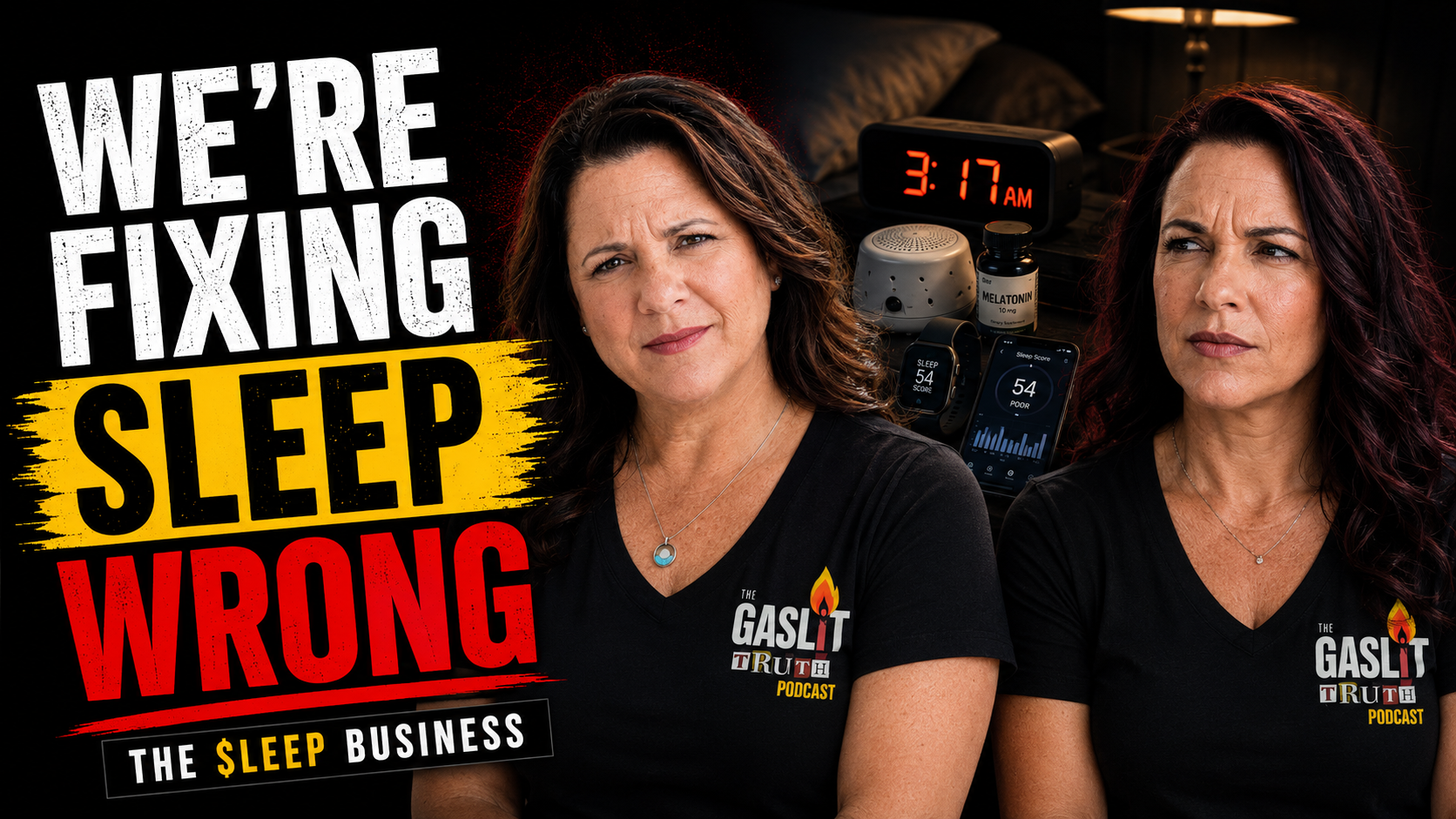
this week on the gaslit truth podcast
Conversations worth having.
The Gaslit Truth Podcast goes where mental health conversations usually stop. We question the assumptions, examine the evidence, and talk openly about what gets left out.
Start with what’s actually going on, not just what you’ve been told.
Tell me what you’re trying to solve — we’ll figure out where to start.